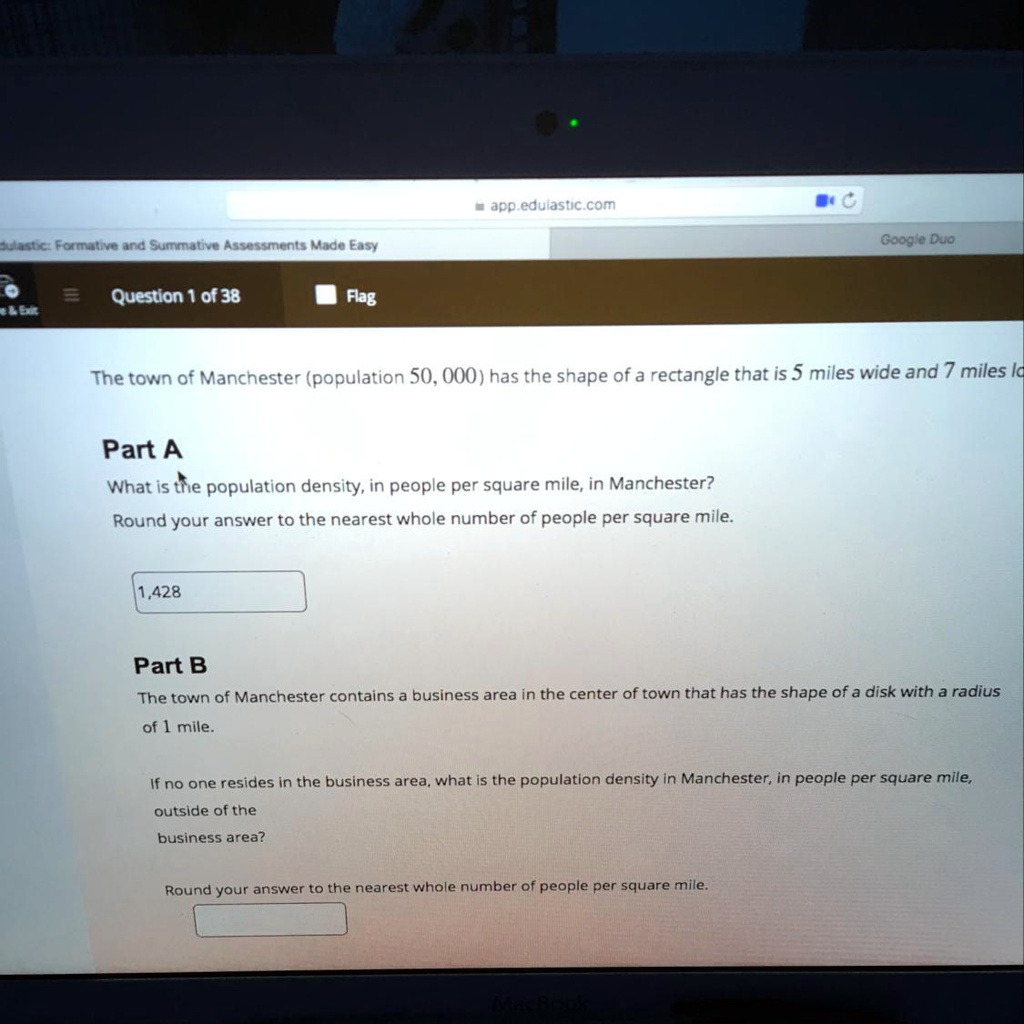
The town of Manchester (population 50,000) has the shape of a rectangle that is 5 miles wide and 7 miles lo Part A What is the population density, in people per square mile, in Manchester? Round your answer to the nearest whole number of people per square mile. 1,428 Part B The town of Manchester contains a business area in the center of town that has the shape of a disk with a radius of 1 mile. If no one resides in the business area, what is the population density in Manchester, in people per square mile, outside of the business area? Round your answer to the nearest whole number of people per square mile.
The Correct Answer and Explanation is:
The correct answer for Part B is 1,569.
Here is a detailed explanation of how to arrive at this answer.
To solve Part B, we must calculate the population density for the area of Manchester where people actually live. The problem states that no one resides in the central business area. Therefore, we need to find the size of this new residential area first.
Step 1: Calculate the total area of the town.
The town of Manchester is a rectangle with a width of 5 miles and a length of 7 miles. The formula for the area of a rectangle is length multiplied by width.
Total Area = 7 miles × 5 miles = 35 square miles.
Step 2: Calculate the area of the business district.
The business area is described as a disk, which is a circle, with a radius of 1 mile. The formula for the area of a circle is A = πr², where ‘r’ is the radius.
Business Area = π × (1 mile)² = π square miles.
Using the value of π ≈ 3.14159, the business area is approximately 3.14159 square miles.
Step 3: Determine the residential area.
Since the entire population of 50,000 lives outside the business district, we must subtract the business area from the town’s total area to find the residential area.
Residential Area = Total Area – Business Area
Residential Area = 35 – π square miles
Residential Area ≈ 35 – 3.14159 ≈ 31.85841 square miles.
Step 4: Calculate the new population density.
Population density is calculated by dividing the total population by the area they occupy. In this case, the entire population of 50,000 people lives in the calculated residential area.
Population Density = Total Population / Residential Area
Population Density = 50,000 / (35 – π)
Population Density ≈ 50,000 / 31.85841 ≈ 1569.45 people per square mile.
Step 5: Round to the nearest whole number.
The problem requires the final answer to be rounded to the nearest whole number. The calculated value is 1569.45. Since the decimal part (.45) is less than .5, we round down.
The final population density is 1,569 people per square mile.