The Correct Answer and Explanation is:
Here are the correct descriptions of the transformations for each function, followed by a detailed explanation.
Correct Answers
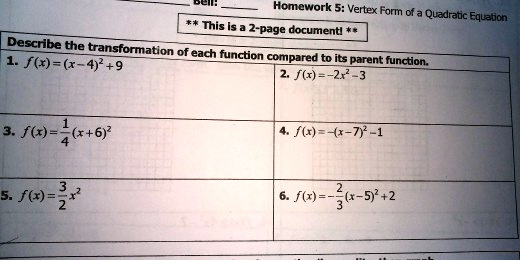
- f(x) = (x – 4)² + 9: The parent function is translated 4 units to the right and 9 units up.
- f(x) = -2x² – 3: The parent function is reflected across the x-axis, vertically stretched by a factor of 2, and translated 3 units down.
- f(x) = ¼(x + 6)²: The parent function is vertically compressed by a factor of 1/4 and translated 6 units to the left.
- f(x) = -(x – 7)² – 1: The parent function is reflected across the x-axis, translated 7 units to the right, and 1 unit down.
- f(x) = (3/2)x²: The parent function is vertically stretched by a factor of 3/2.
- f(x) = -⅔(x – 5)² + 2: The parent function is reflected across the x-axis, vertically compressed by a factor of 2/3, translated 5 units to the right, and 2 units up.
Explanation
Understanding the transformations of a quadratic function involves comparing it to its parent function, f(x) = x². The vertex form, f(x) = a(x – h)² + k, provides a clear guide to these changes. Each parameter, a, h, and k, corresponds to a specific transformation that alters the shape, orientation, or position of the parent parabola.
The parameter a determines the parabola’s vertical scale and orientation. If a is negative, the parabola reflects across the x-axis and opens downward. If the absolute value of a is greater than 1, the graph is vertically stretched, making it appear narrower than the parent function. If the absolute value of a is between 0 and 1, the graph is vertically compressed, or shrunk, which makes it appear wider.
The parameter h dictates the horizontal shift, or translation, of the parabola. The graph moves h units to the right for a term like (x – h). Conversely, it moves h units to the left for a term like (x + h), because this can be rewritten as (x – (-h)).
Finally, the parameter k controls the vertical shift. A positive value for k moves the graph upward by k units, while a negative value for k moves it downward by k units. The combination of these shifts moves the vertex of the parabola from the origin (0,0) of the parent function to a new location at the point (h, k). By analyzing these three parameters for each equation, we can fully describe its transformation from the original f(x) = x².