Classify each of the following as a pure substance or a mixture (write it in the first column). If it is a pure substance, then write either element or compound in the second column. If it is a mixture, then write homogeneous or heterogeneous in the second column. Please write the complete words to receive full credit: Material Concrete Aluminum foil Gold plated jewelry Graphite Saline solution Distilled water Distilled white vinegar Carbon dioxide Brass Table salt
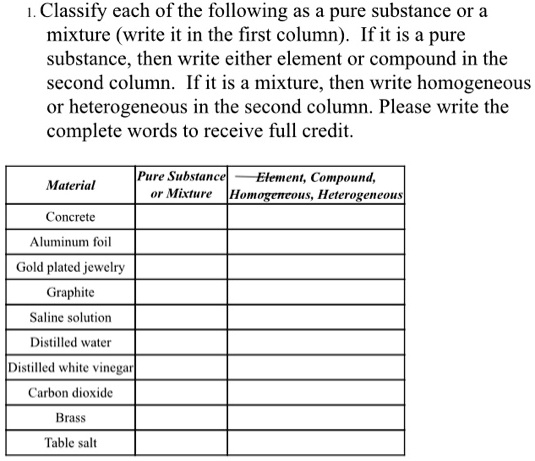
The Correct Answer and Explanation is:
Of course. Here is the completed table and a detailed explanation for the classifications.
Completed Table:
Material Pure Substance or Mixture Element, Compound, Homogeneous, Heterogeneous
Concrete Mixture Heterogeneous
Aluminum foil Pure Substance Element
Gold plated jewelry Mixture Heterogeneous
Graphite Pure Substance Element
Saline solution Mixture Homogeneous
Distilled water Pure Substance Compound
Distilled white vinegar Mixture Homogeneous
Carbon dioxide Pure Substance Compound
Brass Mixture Homogeneous
Table salt Pure Substance Compound
Explanation of Classifications
This exercise involves classifying materials based on their chemical composition and the uniformity of their mixtures. Matter can be broadly divided into pure substances and mixtures.
A pure substance has a fixed chemical composition and distinct properties. It cannot be separated into simpler components by physical means. Pure substances are further classified as elements or compounds. An element is the simplest form of a pure substance, consisting of only one type of atom (e.g., Aluminum, Carbon). A compound is a pure substance made of two or more different elements chemically bonded together in a fixed ratio (e.g., H₂O, NaCl).
In the table, aluminum foil and graphite are elements, as they are composed solely of aluminum (Al) and carbon (C) atoms, respectively. Distilled water (H₂O), carbon dioxide (CO₂), and table salt (NaCl) are compounds because they consist of different elements chemically bonded in a constant proportion.
A mixture consists of two or more substances that are physically combined but not chemically bonded. Their composition can vary. Mixtures are classified as homogeneous or heterogeneous. A homogeneous mixture has a uniform composition throughout, meaning the different components are not visibly distinguishable. These are also called solutions. A heterogeneous mixture has a non-uniform composition, and its individual components are often visible.
Saline solution (salt in water), distilled white vinegar (acetic acid in water), and brass (an alloy of copper and zinc) are homogeneous mixtures. In each case, the components are evenly distributed, creating a single, uniform phase. In contrast, concrete is a heterogeneous mixture because you can see the distinct components like sand, gravel, and cement. Gold plated jewelry is also heterogeneous; it is not a uniform mix of gold and another metal but rather a distinct layer of gold over a different base metal, making its composition non-uniform throughout the entire object.