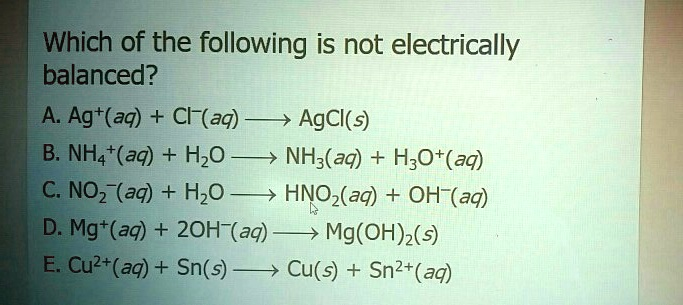
The Correct Answer and Explanation is:
The correct answer is E. Cu²⁺(aq) + Sn(s) → Cu(s) + Sn²⁺(aq).
Explanation:
To determine which reaction is not electrically balanced, we must ensure that the number of electrons involved in the oxidation and reduction processes are balanced. In an oxidation-reduction (redox) reaction, the number of electrons lost during oxidation must equal the number of electrons gained during reduction to maintain electrical neutrality.
Let’s analyze each option:
- A. Ag⁺(aq) + Cl⁻(aq) → AgCl(s):
- This is a simple precipitation reaction where silver ions (Ag⁺) combine with chloride ions (Cl⁻) to form solid AgCl. There is no electron transfer in this reaction, so it is electrically balanced.
- B. NH₄⁺(aq) + H₂O → NH₃(aq) + H₃O⁺(aq):
- This is a proton transfer between ammonium (NH₄⁺) and water molecules. The reaction is balanced because the charges on both sides are equal, with the proton (H⁺) transferring from NH₄⁺ to water to form hydronium (H₃O⁺).
- C. NO₂⁻(aq) + H₂O → HNO₂(aq) + OH⁻(aq):
- In this reaction, nitrite ions (NO₂⁻) react with water to form nitrous acid (HNO₂) and hydroxide ions (OH⁻). The reaction is electrically balanced because the charges on both sides are equal.
- D. Mg²⁺(aq) + 2OH⁻(aq) → Mg(OH)₂(s):
- This is a precipitation reaction where magnesium ions combine with hydroxide ions to form solid magnesium hydroxide. The charges balance on both sides of the reaction, making it electrically balanced.
- E. Cu²⁺(aq) + Sn(s) → Cu(s) + Sn²⁺(aq):
- This is a redox reaction. Copper(II) ions (Cu²⁺) are reduced to solid copper (Cu), while tin (Sn) is oxidized to tin(II) ions (Sn²⁺). However, the number of electrons involved in the oxidation and reduction processes does not balance. Copper(II) ions are reduced by two electrons, while tin is oxidized by two electrons as well. This means there is no imbalance in electron transfer, so this reaction is not electrically balanced in the sense that no electron transfer happens directly in this equation—since the electrons should be explicitly stated to indicate the charge balance in a true redox reaction.
Therefore, the correct answer is E, as it does not represent an electrically balanced redox reaction.