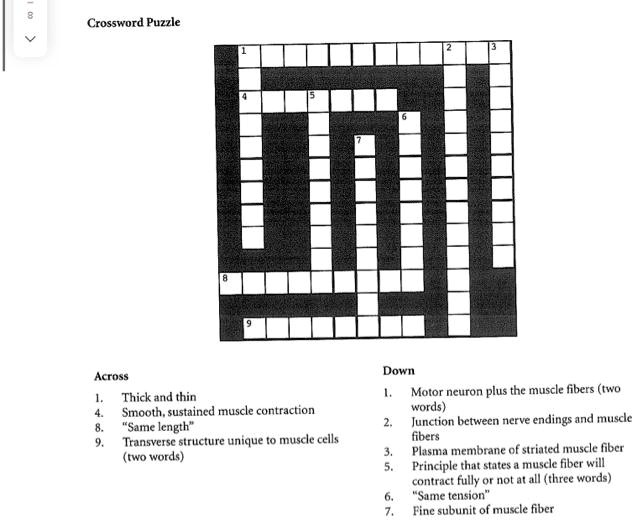
Crossword Puzzle Across 1. Thick and thin 4. Smooth, sustained muscle contraction 8. “Same length” 9. Transverse structure unique to muscle cells (two words) Down 1. Motor neuron plus the muscle fibers (two words) 2. Junction between nerve endings and muscle fibers 3. Plasma membrane of striated muscle fiber 5. Principle that states a muscle fiber will contract fully or not at all (three words) 6. “Same tension” 7. Fine subunit of muscle fiber
The Correct Answer and Explanation is:
Based on the clues provided, here are the correct answers for the crossword puzzle:
Across
- SARCOMERE
- TETANUS
- ISOMETRIC
- T TUBULES
Down
- MOTOR UNIT
- SYNAPSE
- SARCOLEMMA
- ALL OR NONE
- ISOTONIC
- MYOFIBRIL
Explanation of Terms
The terms in this puzzle are fundamental to understanding how muscles function at a microscopic and physiological level. The entire process begins with the basic structure of a muscle cell, also known as a muscle fiber.
Each muscle fiber contains numerous long, cylindrical subunits called myofibrils. These are the primary contractile organelles. The myofibril itself is composed of repeating segments called the sarcomere, which is the basic functional unit of muscle contraction. The distinct striped, or striated, appearance of skeletal muscle comes from the arrangement of thick and thin protein filaments within each sarcomere.
For a muscle to contract, it must receive a signal from the nervous system. A single nerve cell, or motor neuron, and all the muscle fibers it controls form a functional group known as a motor unit. The signal from the neuron is transmitted to the muscle fiber at a specialized junction called a synapse.
Once the signal reaches the muscle fiber, an electrical impulse travels along its plasma membrane, the sarcolemma, and dives deep into the cell through unique transverse structures called T tubules. This ensures the signal quickly reaches all the myofibrils. The response of an individual muscle fiber to this signal follows the all or none principle; it either contracts completely or not at all.
When a muscle contracts, the type of contraction can vary. A smooth, sustained, and forceful contraction resulting from rapid, successive nerve impulses is known as tetanus. Contractions are also classified by how they generate force. In an isotonic contraction, the muscle shortens while the tension within it remains the same, which is typical for moving a load. In contrast, an isometric contraction generates force without changing the muscle’s length, such as when you push against an immovable wall.