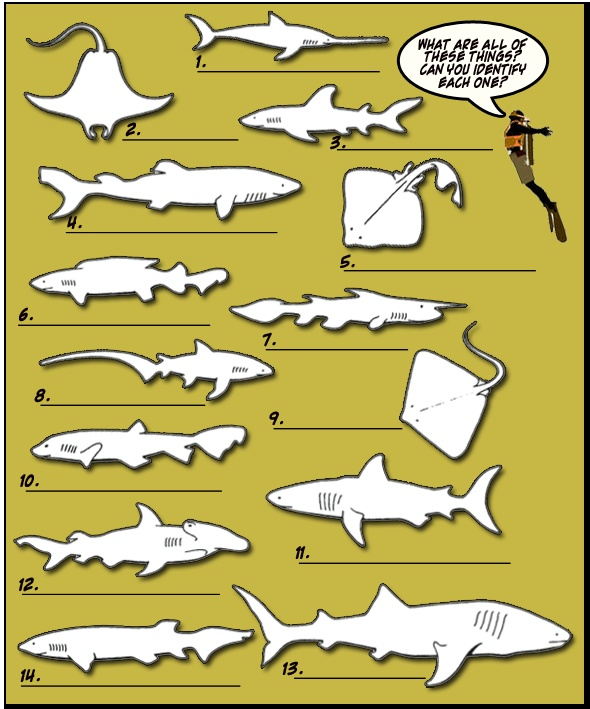
WHAT ARE ALL OF THESE THINGS? CAN YOU IDENTIFY EACH ONE?
The Correct Answer and Explanation is:
Of course! Here are the identifications for each creature in the image, followed by a detailed explanation.
- Sawshark
- Manta Ray
- Blue Shark
- Angelshark
- Guitarfish
- Dogfish Shark
- Wobbegong
- Thresher Shark
- Stingray
- Nurse Shark
- Great White Shark
- Hammerhead Shark
- Bull Shark
- Zebra Shark
The collection of animals shown are all types of elasmobranchs, a class of cartilaginous fish that includes sharks, rays, and skates. This means their skeletons are made of cartilage instead of bone. The image showcases the incredible diversity within this group, from classic predators to highly specialized bottom dwellers and filter feeders.
The sharks are identifiable by their unique body shapes and fins. The Great White Shark (11) has the iconic powerful, torpedo shaped body, while the Thresher Shark (8) is easily recognized by its extremely long upper tail fin, which it uses like a whip to stun prey. The Hammerhead Shark (12) possesses one of the most unusual body plans in the ocean; its wide, flat head, called a cephalofoil, is packed with sensory organs that help it scan the seafloor for food. Other sharks are adapted for life on the bottom. The Angelshark (4) has a flattened body resembling a ray, the Wobbegong (7) has a camouflaged, carpet like appearance, and the Nurse Shark (10) has a rounded head and fins set far back on its body for resting on the seabed.
The rays are distinguished by their flat bodies and large pectoral fins that are fused to their heads, creating a disc shape. The Manta Ray (2) is a gentle giant, identifiable by the cephalic fins on its head which help funnel plankton into its mouth. The Stingray (9) has a more typical diamond shape and a slender, whip like tail that often contains a venomous barb for defense. The Guitarfish (5) represents an evolutionary link between sharks and rays, featuring the flattened head and pectoral fins of a ray but the more shark like tail and dorsal fins. Each of these creatures, from the saw nosed Sawshark (1) to the stocky Bull Shark (13), has evolved a distinct form to thrive in its specific marine environment.