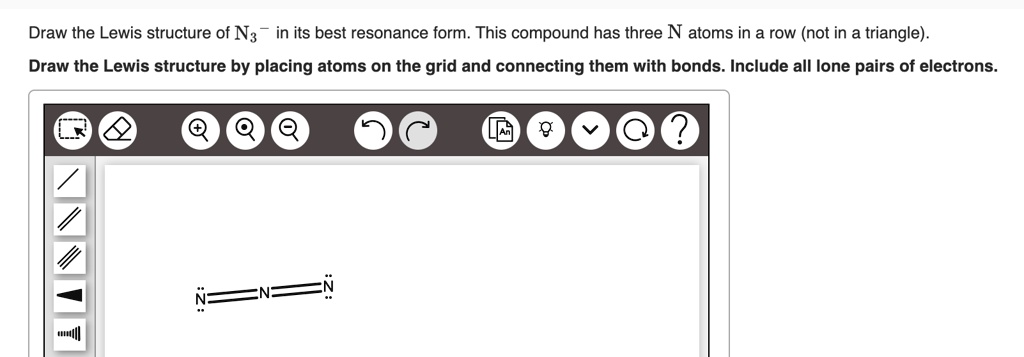
Draw the Lewis structure of N
in its best resonance form. This compound has three N atoms in a row (not in a triangle). Draw the Lewis structure by placing atoms on the grid and connecting them with bonds. Include all lone pairs of electrons.
The Correct Answer and Explanation is:
The chemical formula N₃⁻ represents the azide ion. To determine its best Lewis structure, we follow a systematic approach based on valence electrons and formal charges.
First, we calculate the total number of valence electrons available for bonding. Each nitrogen atom (Group 15) contributes 5 valence electrons. The negative one charge on the ion indicates an additional electron. Therefore, the total count is (3 atoms × 5 electrons/atom) + 1 electron = 16 valence electrons.
The problem specifies that the three nitrogen atoms are arranged in a row (N-N-N). After connecting them with single bonds, which uses 4 electrons, we are left with 12 electrons to distribute.
There are three possible resonance structures that satisfy the octet rule for all atoms:
- A central nitrogen double-bonded to each terminal nitrogen: [:N̈=N=N̈:]⁻
- A terminal nitrogen single-bonded to a central nitrogen which is triple-bonded to the other terminal nitrogen: [:N̈-N≡N:]⁻
- The mirror image of the second structure: [:N≡N-N̈:]⁻
To identify the “best” or most stable resonance form, we calculate the formal charge on each atom for all three structures. The formal charge is calculated as (Valence Electrons) – (Non-bonding Electrons) – (1/2 Bonding Electrons). The most stable structure is the one that minimizes the magnitude of formal charges on the atoms.
- For [:N̈=N=N̈:]⁻:
- Terminal N: 5 – 4 – ½(4) = -1
- Central N: 5 – 0 – ½(8) = +1
- Formal charges: (-1, +1, -1).
- For [:N≡N-N̈:]⁻:
- Triple-bonded N: 5 – 2 – ½(6) = 0
- Central N: 5 – 0 – ½(8) = +1
- Single-bonded N: 5 – 6 – ½(2) = -2
- Formal charges: (0, +1, -2).
The third structure is simply a mirror of the second, with charges (-2, +1, 0).
Comparing these, the first structure, with formal charges of -1, +1, and -1, is the most stable. It distributes the charge more evenly and avoids a large formal charge of -2 on a single atom, which is highly unfavorable. Therefore, the structure with two double bonds is the best resonance form and the major contributor to the overall structure of the azide ion.