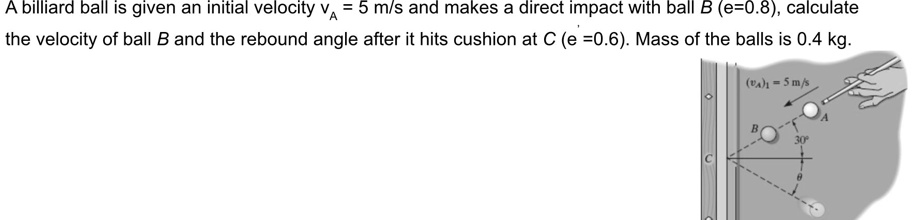
A billiard ball is given an initial velocity V=5M/S and makes a direct impact with ball B (e=0.8), calculate the velocity of ball B and the rebound angle after it hits cushion at C (e =0.6). Mass of the balls is 0.4 kg.
The Correct Answer and Explanation is:
Correct Answer
The velocity of ball B immediately after the impact with ball A is v_B = 3.90 m/s.
The rebound angle after ball B hits cushion C is θ = 43.9°.
Explanation
This problem is solved in two parts: the collision between the two balls and the subsequent collision of ball B with the cushion.
Part 1: Collision of Ball A and Ball B
First, we analyze the oblique impact between ball A and ball B. We establish a coordinate system with the n-axis along the line of impact (connecting the centers of the balls, at 30° to the horizontal) and the t-axis perpendicular to it.
Ball A’s initial velocity, (v_A)₁ = 5 m/s, is horizontal. We resolve this into n and t components:
- (v_A)₁n = 5 * cos(30°) = 4.33 m/s
- (v_A)₁t = 5 * sin(30°) = 2.5 m/s
Ball B is initially at rest, so (v_B)₁n = 0 and (v_B)₁t = 0.
During the impact, the velocity components perpendicular to the line of impact (t-axis) are conserved for each ball. Therefore, the velocity of ball B in the t-direction after impact, (v_B)₂t, remains 0.
Along the line of impact (n-axis), we use the conservation of momentum and the coefficient of restitution (e = 0.8). Since the masses are equal, the equations simplify:
- Conservation of Momentum: (v_A)₁n + (v_B)₁n = (v_A)₂n + (v_B)₂n => 4.33 = (v_A)₂n + (v_B)₂n
- Coefficient of Restitution: e = [(v_B)₂n – (v_A)₂n] / [(v_A)₁n – (v_B)₁n] => 0.8 = [(v_B)₂n – (v_A)₂n] / 4.33
Solving these two equations simultaneously gives the velocity of ball B along the n-axis: (v_B)₂n = 3.897 m/s. Since its t-component is zero, the total velocity of ball B after impact is v_B ≈ 3.90 m/s, directed along the 30° line of impact.
Part 2: Collision of Ball B with Cushion C
Next, ball B, traveling at 3.90 m/s at 30° to the horizontal, strikes the vertical cushion C. We use a new coordinate system: x-axis normal to the cushion (horizontal) and y-axis tangential to it (vertical).
The components of ball B’s velocity just before hitting the cushion are:
- (v_Bx)_before = 3.897 * cos(30°) = 3.375 m/s
- (v_By)_before = 3.897 * sin(30°) = 1.949 m/s
For impact with the cushion, the tangential velocity component (y-direction) is conserved: (v_By)_after = 1.949 m/s.
The normal velocity component (x-direction) is determined by the coefficient of restitution e’ = 0.6:
- (v_Bx)_after = e’ * (v_Bx)_before = 0.6 * 3.375 = 2.025 m/s
The rebound angle θ is found using the components of the final velocity:
- tan(θ) = (v_By)_after / (v_Bx)_after = 1.949 / 2.025 = 0.9625
- θ = arctan(0.9625) = 43.9°