The molar mass of Potassium chlorate is molar mass for potassium = 39.1 g/mol, chlorine = 35.5 g/mol, and Oxygen = 16 g/mol.
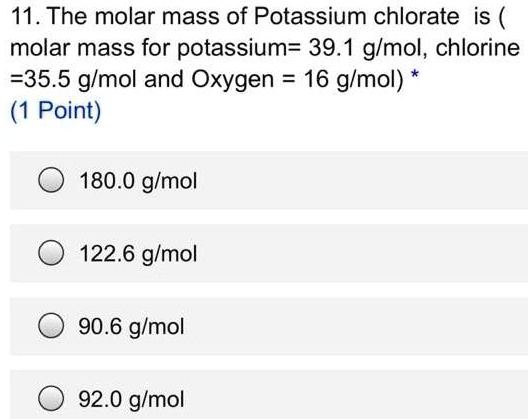
The Correct Answer and Explanation is:
The correct answer is 122.6 g/mol .
To find the molar mass of a chemical compound, you must sum the molar masses of all the individual atoms in its formula. This calculation requires a few systematic steps.
First, it is essential to determine the correct chemical formula for potassium chlorate. The name itself provides clues. “Potassium” refers to the element K, which is an alkali metal and forms an ion with a +1 charge (K⁺). “Chlorate” is the name for the polyatomic ion with the formula ClO₃⁻, which has a -1 charge. For a compound to be electrically neutral, the total positive charge must balance the total negative charge. In this instance, one potassium ion (K⁺) will balance one chlorate ion (ClO₃⁻). Therefore, the chemical formula for potassium chlorate is KClO₃.
Second, we need to identify the number of atoms of each element present in one formula unit of KClO₃. By looking at the subscripts in the formula, we can see there is:
- One atom of Potassium (K)
- One atom of Chlorine (Cl)
- Three atoms of Oxygen (O)
Third, we use the given molar masses for each element:
- Potassium (K) = 39.1 g/mol
- Chlorine (Cl) = 35.5 g/mol
- Oxygen (O) = 16 g/mol
Finally, we calculate the total molar mass. We multiply the number of atoms of each element by its molar mass and then add all the results together.
- Mass from potassium: 1 atom × 39.1 g/mol = 39.1 g/mol
- Mass from chlorine: 1 atom × 35.5 g/mol = 35.5 g/mol
- Mass from oxygen: 3 atoms × 16 g/mol = 48.0 g/mol
Now, we sum these values to get the molar mass of KClO₃:
Total Molar Mass = 39.1 + 35.5 + 48.0 = 122.6 g/mol .
This result matches the second option in the multiple choice list, confirming it is the correct answer.