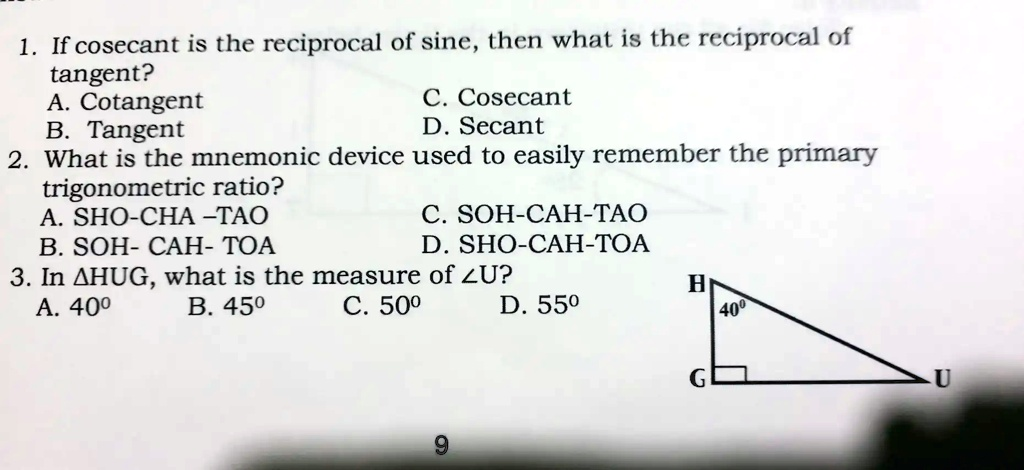
If cosecant is the reciprocal of sine, then what is the reciprocal of tangent? A. Cotangent B. Tangent C. Cosecant D. Secant 2. What is the mnemonic device used to easily remember the primary trigonometric ratio? A. SHO-CHA-TAO B. SOH- CAH- TOA C. SOH-CAH-TAO D. SHO-CAH-TOA 3. In
, what is the measure of
? A. 40° B. 45° C. 50° D. 55° H 40° G U
The Correct Answer and Explanation is:
Here are the correct answers to the questions, followed by a detailed explanation.
1. A. Cotangent
2. C. SOH-CAH-TAO (Note: Although the provided image has typographical errors in the options, this choice represents the universally recognized mnemonic for trigonometric ratios.)
3. C. 50°
Explanation
1. Reciprocal of Tangent
The field of trigonometry is built upon six primary functions that relate the angles of a right triangle to the ratios of its side lengths. These six functions are organized into three reciprocal pairs. A reciprocal of a number is simply 1 divided by that number. In trigonometry, this concept applies to the functions themselves.
The question first establishes a known pair: cosecant (csc) is the reciprocal of sine (sin). This means csc(θ) = 1/sin(θ). Following this pattern, the other two pairs are:
- Secant (sec) is the reciprocal of cosine (cos), meaning sec(θ) = 1/cos(θ).
- Cotangent (cot) is the reciprocal of tangent (tan), meaning cot(θ) = 1/tan(θ).
Therefore, when asked for the reciprocal of tangent, the correct answer is cotangent. This relationship is fundamental. If we remember that tangent is the ratio of the opposite side to the adjacent side (tan = O/A), then its reciprocal, cotangent, is the ratio of the adjacent side to the opposite side (cot = A/O).
2. The Trigonometric Mnemonic
To remember the definitions of the three most basic trigonometric ratios (sine, cosine, and tangent), students commonly use the mnemonic device SOH-CAH-TOA. This simple acronym is incredibly useful for setting up trigonometric problems correctly. Each three-letter part corresponds to one of the functions:
- SOH: Sine equals Opposite over Hypotenuse (sin θ = Opposite/Hypotenuse).
- CAH: Cosine equals Adjacent over Hypotenuse (cos θ = Adjacent/Hypotenuse).
- TOA: Tangent equals Opposite over Adjacent (tan θ = Opposite/Adjacent).
Looking at the options provided in the image, there appear to be several typographical errors. However, option C, “SOH-CAH-TAO,” is the closest to the correct mnemonic, with only the last part being misspelled (it should be TOA). The other options contain more significant errors, such as “SHO” and “CHA,” which do not correspond to any standard trigonometric term. Assuming a typo, SOH-CAH-TOA is the correct mnemonic device.
3. Finding the Angle in Triangle HUG
This question requires applying a core principle of geometry: the sum of the interior angles in any triangle is always 180 degrees.
The image displays a triangle named ΔHUG. We are given the following information:
- The angle at vertex H, ∠H, is 40°.
- There is a square symbol at vertex G, which indicates a right angle. Therefore, the angle at vertex G, ∠G, is 90°.
- We need to find the measure of the angle at vertex U, ∠U.
We can set up an equation using the angle sum property:
∠H + ∠G + ∠U = 180°
Now, we substitute the known values into the equation:
40° + 90° + ∠U = 180°
Combining the known angles gives us:
130° + ∠U = 180°
To find ∠U, we subtract 130° from both sides of the equation:
∠U = 180° – 130°
∠U = 50°
Alternatively, a useful shortcut for right-angled triangles is that the two acute angles (the non-right angles) are complementary, meaning they must add up to 90°. Therefore, we can find ∠U by simply subtracting ∠H from 90°:
∠U = 90° – 40° = 50°.