It takes an operator 1 minute to service a machine and 0.1 minute to walk to the next machine
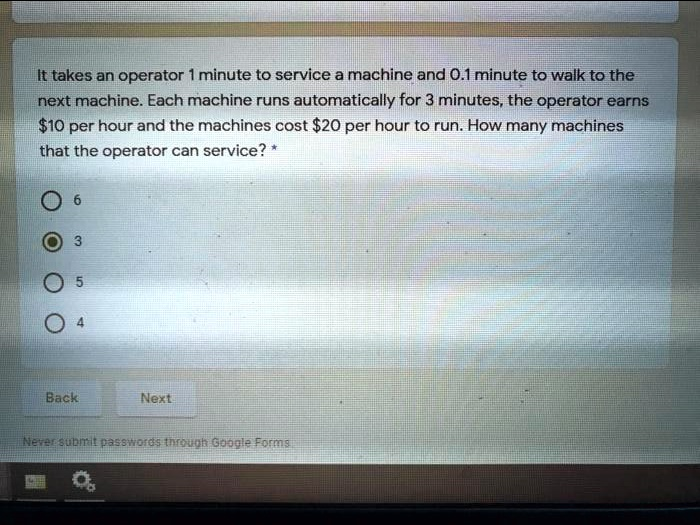
The Correct Answer and Explanation is:
The correct answer is 3.
This problem requires finding the maximum number of machines an operator can handle without any machine experiencing downtime while waiting for service. To solve this, we must compare the operator’s work cycle to the machine’s automatic run time.
First, let’s calculate the total time the operator spends on each machine in a cycle. This includes both servicing and walking.
- Service time per machine = 1 minute
- Walk time to the next machine = 0.1 minute
- Total operator time per machine = 1 + 0.1 = 1.1 minutes
Let N represent the total number of machines the operator can service. The operator moves in a continuous loop from one machine to the next. The total time for the operator to complete one full loop and return to the starting machine is the time per machine multiplied by the number of machines.
- Operator’s full cycle time = 1.1 * N minutes
The key constraint is the machine’s automatic run time, which is 3 minutes. After an operator services a machine, they move on to the others. The time the operator is away from that first machine must be less than or equal to its 3 minute run time. If the operator takes longer than 3 minutes to return, the machine will sit idle.
The time the operator is away from any given machine is their total cycle time (1.1 * N) minus the 1 minute they spent servicing that specific machine. This leads to the inequality:
(1.1 * N) – 1 ≤ 3
To find the maximum value for N, we solve the inequality:
1.1 * N ≤ 4
N ≤ 4 / 1.1
N ≤ 3.636…
Since N must be a whole number of machines, we take the largest integer that satisfies the condition. Therefore, the maximum number of machines the operator can service is 3. The information about the operator’s earnings and machine costs is not relevant to this calculation.