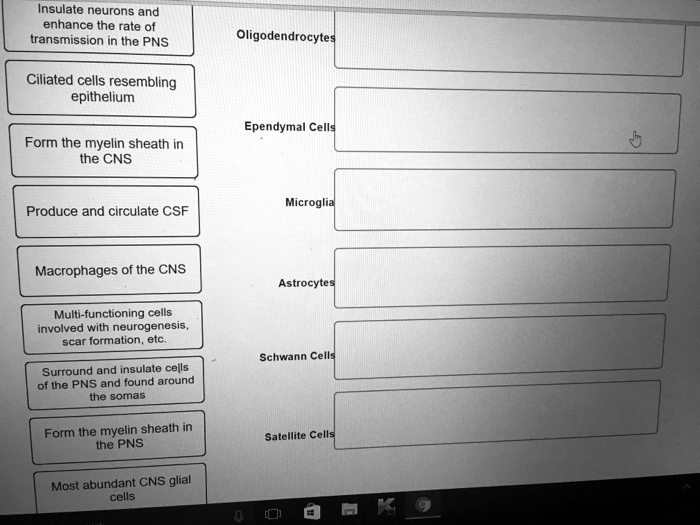
Insulate neurons and enhance the rate of transmission in the PNS Oligodendrocytes Ciliated cells resembling epithelium Ependymal Cells Form the myelin sheath in the CNS Microglia Produce and circulate CSF Astrocytes Macrophages of the CNS Schwann Cells Multi-functioning cells involved with neurogenesis, scar formation, etc. Satellite Cells Surround and insulate cells of the PNS and found around the somas Form the myelin sheath in the PNS Most abundant CNS glial cells
The Correct Answer and Explanation is:
Of course. Here is the correct solution to the matching exercise, followed by a detailed explanation.
Correct Answer
Here are the correct pairings for each glial cell type:
- Oligodendrocytes:
- Form the myelin sheath in the CNS
- Ependymal Cells:
- Ciliated cells resembling epithelium
- Produce and circulate CSF
- Microglia:
- Macrophages of the CNS
- Astrocytes:
- Multi-functioning cells involved with neurogenesis, scar formation, etc.
- Most abundant CNS glial cells
- Schwann Cells:
- Insulate neurons and enhance the rate of transmission in the PNS
- Form the myelin sheath in the PNS
- Satellite Cells:
- Surround and insulate cells of the PNS and found around the somas
Explanation
This exercise tests knowledge of neuroglia, or glial cells, which are the non-neuronal support cells of the nervous system. They are crucial for the health and function of neurons. The nervous system is divided into the Central Nervous System (CNS), which includes the brain and spinal cord, and the Peripheral Nervous System (PNS), which comprises all other nervous tissue.
Glial Cells of the CNS:
- Astrocytes are the most numerous glial cells in the CNS. These star shaped cells have many vital roles, including providing structural support, regulating the chemical environment around neurons, contributing to the blood brain barrier, and forming scar tissue after injury (a process called gliosis). This makes them the “most abundant” and “multi-functioning” cells.
- Oligodendrocytes are responsible for producing the myelin sheath, a fatty substance that insulates axons within the CNS. A single oligodendrocyte can myelinate segments of multiple axons, which significantly increases the speed of electrical signal transmission.
- Microglia are the specialized immune cells of the CNS. They act as macrophages, constantly surveying the environment for pathogens, dead cells, and debris, which they then phagocytose or engulf.
- Ependymal Cells line the ventricles of the brain and the central canal of the spinal cord. These cells, which resemble epithelial tissue, have cilia on their surface that help circulate cerebrospinal fluid (CSF). They also play a role in producing CSF.
Glial Cells of the PNS:
- Schwann Cells are the PNS equivalent of oligodendrocytes. They form the myelin sheath around axons in the peripheral nerves. This myelination serves to insulate the neuron and enhance the rate of signal transmission, a function known as saltatory conduction.
- Satellite Cells surround the cell bodies (somas) of neurons located in PNS ganglia. They provide structural support and regulate the microenvironment around these cell bodies, similar to the function of astrocytes in the CNS.