Gram stain Endospore stain Acid fast stain
The Correct Answer and Explanation is:
Based on the three staining procedures shown, the bacterium is a species of the genus Bacillus.
Explanation
This identification is based on a collective analysis of the results from the Gram stain, endospore stain, and acid-fast stain.
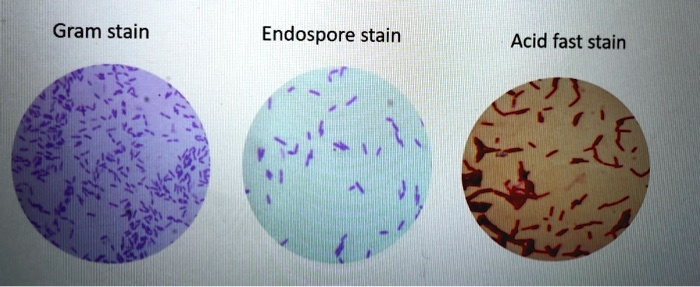
- Gram Stain: The first image shows the result of a Gram stain. The bacteria are rod-shaped (bacilli) and have stained a deep purple color. This indicates that they are Gram-positive. Gram-positive bacteria have a thick peptidoglycan layer in their cell wall, which retains the primary crystal violet stain even after the decolorization step, resulting in the purple appearance.
- Endospore Stain: The second image displays an endospore stain. We can observe rod-shaped vegetative cells stained purple, and within many of these cells are clear, unstained oval structures. These are endospores. Endospores are dormant, tough, non-reproductive structures produced by certain bacteria to survive extreme environmental conditions. The ability to form endospores is a key characteristic of the genera Bacillus and Clostridium, both of which are Gram-positive rods. This result strongly narrows the identification to one of these two genera.
- Acid-Fast Stain: The third image shows an acid-fast stain, where the bacteria have stained red. This is characteristic of an acid-fast positive result. Typically, this stain is used to identify bacteria from the genus Mycobacterium, which have a waxy mycolic acid layer in their cell walls that resists decolorization by acid-alcohol. However, Mycobacterium species do not form endospores. This creates an apparent contradiction.
Conclusion:
The most logical conclusion is that the bacterium is a Bacillus species. The evidence from the Gram stain (Gram-positive bacillus) and the endospore stain (presence of endospores) is definitive for this genus. While Bacillus species are generally considered non-acid-fast, some species, particularly in older cultures, can show a variable or weakly positive acid-fast reaction. Furthermore, the endospores themselves are highly resistant to staining and can appear acid-fast. Therefore, Bacillus is the only genus that fits all three microscopic observations, with the acid-fast result being an atypical but plausible characteristic.