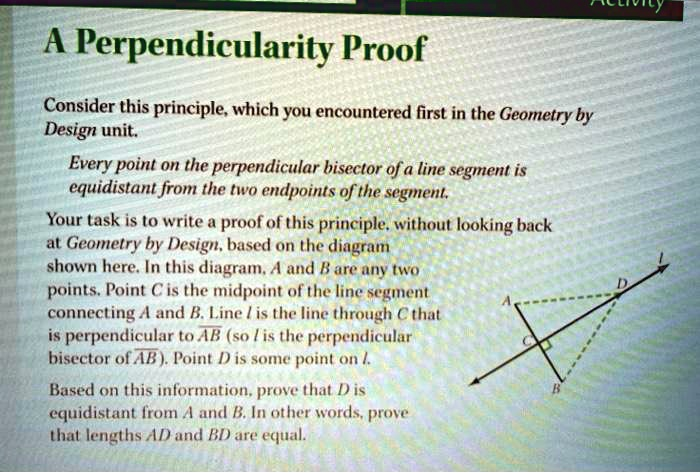
A Perpendicularity Proof Consider this principle, which you encountered first in the Geometry by Design unit: Every point on the perpendicular bisector of a line segment is equidistant from the two endpoints of the segment. Your task is to write and prove this principle without looking back at Geometry by Design, based on the diagram shown here: In this diagram, points A and B are endpoints of the line segment AB. Point E is the midpoint of the line segment connecting A and B. Line CD is the line through E that is perpendicular to AB (so CD is the perpendicular bisector of AB). Point D is some point on CD. Based on this information, prove that D is equidistant from A and B. In other words, prove that lengths AD and BD are equal.
The Correct Answer and Explanation is:
Based on the information and diagram provided, here is a proof that point D is equidistant from points A and B.
Proof:
To prove that point D is equidistant from points A and B, we must show that the length of segment AD is equal to the length of segment BD. We can achieve this by proving that triangle ACD is congruent to triangle BCD.
- Segment AC is congruent to segment BC.
We are given that line l is the perpendicular bisector of the segment AB and that it passes through point C. The definition of a bisector means that C is the midpoint of AB. By the definition of a midpoint, point C divides the segment AB into two equal segments. Therefore, the length of AC is equal to the length of BC. - Angle ACD is congruent to angle BCD.
We are given that line l is perpendicular to the segment AB. By the definition of perpendicular lines, they intersect to form right angles (90-degree angles). Thus, both angle ACD and angle BCD are right angles. Since all right angles are equal in measure, these two angles are congruent. - Segment CD is congruent to segment CD.
This segment is a shared side for both triangle ACD and triangle BCD. According to the Reflexive Property of Congruence, any geometric figure is congruent to itself. Therefore, segment CD is congruent to segment CD.
By using the Side-Angle-Side (SAS) Congruence Postulate, we can now conclude that triangle ACD is congruent to triangle BCD. We have established a pair of congruent sides (AC ≅ BC), a congruent included angle (∠ACD ≅ ∠BCD), and another pair of congruent sides (CD ≅ CD).
Since the two triangles are congruent, their corresponding parts must also be congruent. This is known as the principle that Corresponding Parts of Congruent Triangles are Congruent (CPCTC). The side AD of triangle ACD corresponds to the side BD of triangle BCD.
Therefore, segment AD is congruent to segment BD, which means their lengths are equal (AD = BD). This completes the proof that any point D on the perpendicular bisector of a segment AB is equidistant from the endpoints A and B.