Which ray diagram demonstrates the phenomenon of refraction?
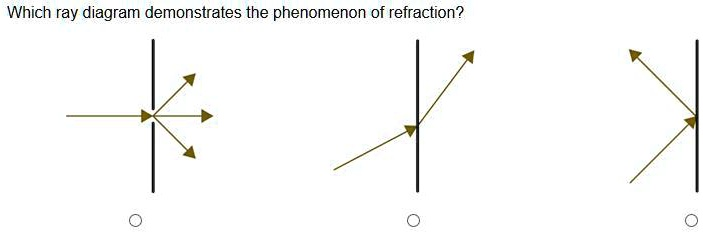
The Correct Answer and Explanation is:
The phenomenon of refraction occurs when light passes from one medium into another, causing a change in speed and direction of the light ray. This bending of light is described by Snell’s Law. A ray diagram demonstrating refraction typically shows light passing from one medium, like air, into another medium, like water or glass. Here’s how a typical ray diagram of refraction looks:
- Incident Ray: The incoming ray is drawn from the source (such as a flashlight or the sun), which is in the first medium (like air).
- Normal Line: A perpendicular line drawn to the boundary of the two media at the point of incidence. This line is essential for measuring angles.
- Refraction at the Boundary: When the light enters the second medium (for example, water), it slows down or speeds up, depending on the refractive index of the second medium compared to the first.
- Refracted Ray: This ray bends at the boundary. If the light enters a denser medium (like water), it bends towards the normal line; if it enters a less dense medium, it bends away from the normal.
For example, if light travels from air (refractive index of 1) into water (refractive index of 1.33), it will bend towards the normal as it enters the water. This happens because the speed of light decreases in the water, causing the change in direction.
A diagram of this process would show:
- The incident ray approaching the water surface.
- The normal line at the point where the ray hits the surface.
- The refracted ray bending into the water at a smaller angle to the normal than the incident ray.
- The angles involved are measured between the ray and the normal line (incident angle and refracted angle).
This bending phenomenon of light due to refraction is crucial for understanding optical systems like lenses and prisms, and it is widely applied in technologies like eyeglasses, cameras, and microscopes.