What is the molecular geometry of theCO₃²⁻ ion
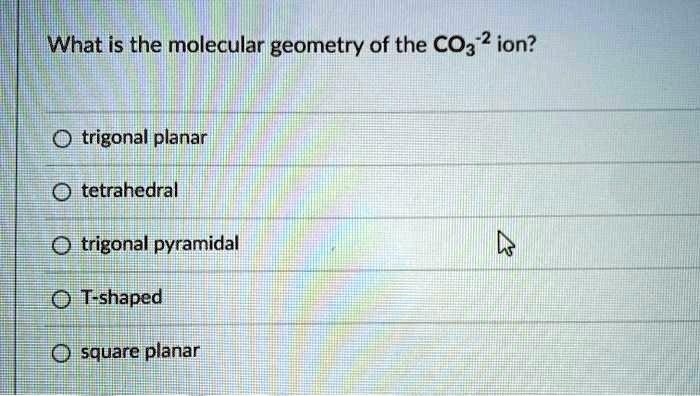
The Correct Answer and Explanation is:
The correct answer is trigonal planar.
Explanation:
The carbonate ion (CO₃²⁻) has a trigonal planar molecular geometry. This structure arises because the ion has three bonding pairs of electrons and no lone pairs on the central carbon atom. Here’s how it works:
- Electron Distribution: In CO₃²⁻, the central carbon atom is bonded to three oxygen atoms, and the ion has a -2 charge. The three oxygen atoms are arranged symmetrically around the central carbon atom in a flat, triangular shape.
- Electron Pair Geometry: Since there are three regions of electron density (the bonds to the three oxygens), the electron pair geometry is trigonal planar. This geometry minimizes electron repulsion, as described by the VSEPR (Valence Shell Electron Pair Repulsion) theory.
- Bonding: The carbon-oxygen bonds in CO₃²⁻ are equivalent, with the bonding electrons delocalized over the entire ion, forming resonance structures. This means that the actual bonding is a hybrid of three possible structures, each with one double bond between the carbon and an oxygen atom, while the others are single bonds with a negative charge.
- Bond Angles: The ideal bond angles in a trigonal planar geometry are 120°, which are observed in CO₃²⁻ due to the symmetrical arrangement of the atoms around the central carbon.
Thus, the CO₃²⁻ ion adopts a trigonal planar molecular geometry, which is characteristic of molecules with three regions of electron density and no lone pairs on the central atom.