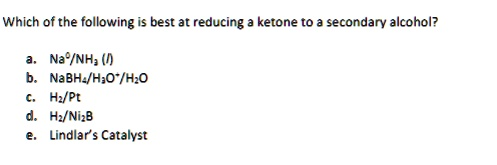
Which of the following is best at reducing a ketone to a secondary alcohol
The Correct Answer and Explanation is:
The correct answer is b. NaBH4/H2O.
Explanation:
To reduce a ketone to a secondary alcohol, the key is to use a reducing agent that is mild enough to avoid over-reduction or unnecessary side reactions. Let’s go over the options:
- Na°/NH3 (l): This is a reaction where sodium metal in liquid ammonia is often used for the reduction of alkynes to trans-alkenes (Birch reduction). It is not suitable for the reduction of a ketone to a secondary alcohol.
- NaBH4/H2O: Sodium borohydride (NaBH4) is a selective reducing agent, commonly used to reduce carbonyl compounds such as aldehydes and ketones to their corresponding alcohols. When NaBH4 is combined with water, it provides the proper conditions for reducing the ketone to a secondary alcohol.
- H2/Pt: Hydrogen gas (H2) in the presence of a platinum (Pt) catalyst can reduce a variety of organic compounds. However, this reaction is more commonly used for reducing alkenes to alkanes and would likely reduce both the carbonyl group and any other double bonds. This makes it too strong for selective reduction of a ketone to a secondary alcohol.
- H2/NiB: This reduction uses hydrogen gas in the presence of a nickel boride (NiB) catalyst, often in hydrogenation reactions. However, it is generally used for reducing aromatic compounds or unsaturated systems, and may not be as specific or mild for ketones as NaBH4.
- Lindlar’s Catalyst: This is a palladium catalyst partially poisoned with lead (Pb), often used for the selective hydrogenation of alkynes to cis-alkenes. It does not affect ketones or reduce them to alcohols.
Thus, NaBH4/H2O is the best choice for reducing a ketone to a secondary alcohol.