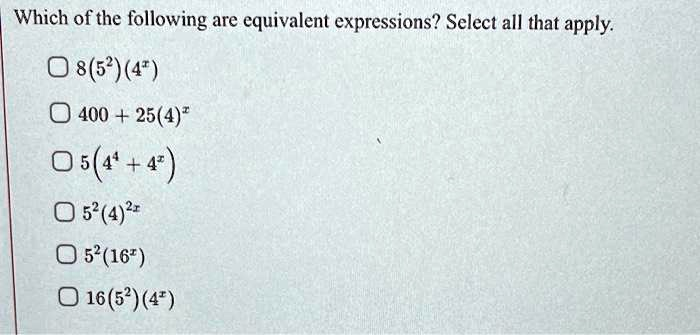
The Correct Answer and Explanation is:
The correct options are the fourth and fifth expressions:
- 5²(4)²ˣ
- 5²(16ˣ)
Here is an explanation of why these expressions are equivalent and the others are not.
To find the equivalent expressions, we need to simplify each option and then compare the results. The key is to apply the rules of exponents, particularly the power of a power rule, which states that (aᵐ)ⁿ = aᵐⁿ.
Let’s examine each expression one by one:
- 8(5²)(4ˣ): We start by simplifying the constant part. 5² is 25. Multiplying 8 by 25 gives us 200. So, this expression simplifies to 200(4ˣ).
- 400 + 25(4)ˣ: This expression involves addition and cannot be simplified into a single product. It will not be equivalent to the other options that are single terms. For example, if x=1, this expression is 400 + 25(4) = 500, while the first expression is 200(4) = 800.
- 5(4⁴ + 4ˣ): Using the distributive property, we get 5(4⁴) + 5(4ˣ). Since 4⁴ = 256, this becomes 5(256) + 5(4ˣ), which is 1280 + 5(4ˣ). This is also an expression with two terms and is not equivalent to the others.
- 5²(4)²ˣ: First, 5² equals 25. For the exponential part, we can use the power of a power rule. (4)²ˣ is equivalent to (4²)ˣ. Since 4² is 16, the term becomes 16ˣ. Combining these parts, the expression simplifies to 25(16ˣ).
- 5²(16ˣ): Here, 5² is 25. The expression simplifies directly to 25(16ˣ).
- 16(5²)(4ˣ): The constant part is 16 multiplied by 5², which is 16 × 25 = 400. This expression simplifies to 400(4ˣ).
After simplifying all the options, we can compare them:
- Option 1: 200(4ˣ)
- Option 2: 400 + 25(4)ˣ
- Option 3: 1280 + 5(4ˣ)
- Option 4: 25(16ˣ)
- Option 5: 25(16ˣ)
- Option 6: 400(4ˣ)
As you can see, the simplified forms of the fourth and fifth expressions are identical. Therefore, 5²(4)²ˣ and 5²(16ˣ) are the only equivalent expressions in the list.