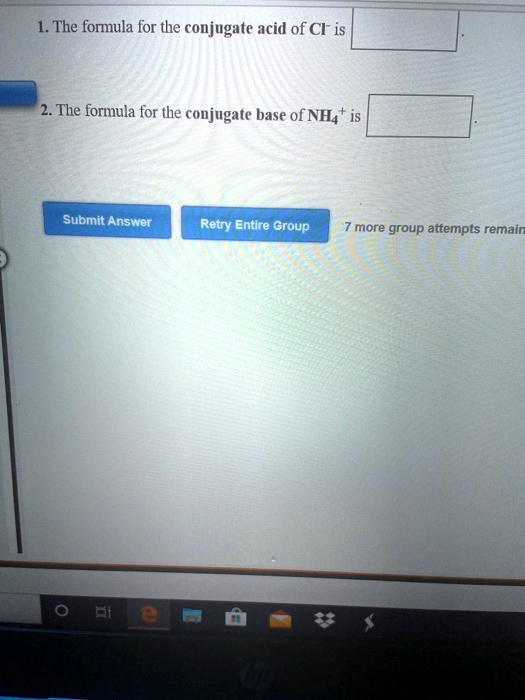
The formula for the conjugate acid of CL is 2. The formula for the conjugate base of ) NH Submit Answer Retry Entire Group more group attempts remair
The Correct Answer and Explanation is:
Correct Answers:
- The formula for the conjugate acid of Cl⁻ is HCl
- The formula for the conjugate base of NH₄⁺ is NH₃
Explanation
In acid-base chemistry, conjugate acid-base pairs are related by the gain or loss of a proton (H⁺).
1. Conjugate Acid of Cl⁻
To find the conjugate acid, you add one proton (H⁺) to the given species.
- Given species: Cl⁻ (chloride ion)
- Add one H⁺: Cl⁻ + H⁺ → HCl
HCl is a strong acid that donates a proton to form Cl⁻ again, showing their conjugate relationship. So, HCl is the conjugate acid of Cl⁻.
2. Conjugate Base of NH₄⁺
To find the conjugate base, you remove one proton (H⁺) from the given species.
- Given species: NH₄⁺ (ammonium ion)
- Remove one H⁺: NH₄⁺ → NH₃ + H⁺
So, NH₃ (ammonia) is the conjugate base of NH₄⁺.
This makes sense because NH₄⁺ can act as an acid and donate a proton to become NH₃, which can then act as a base in reverse.
Summary:
- Conjugate acid of Cl⁻ = HCl
- Conjugate base of NH₄⁺ = NH₃
These pairs follow the Brønsted-Lowry definition of acids and bases, where acids donate protons and bases accept protons. Understanding conjugate pairs helps predict how substances behave in chemical reactions, especially in buffer systems and equilibrium calculations.