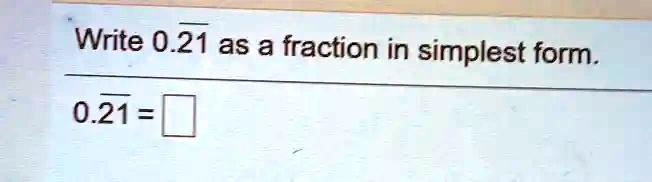
Write 0.21 as a fraction in simplest form.
The Correct Answer and Explanation is:
7/33
The problem requires converting the repeating decimal 0.21 into a fraction in its simplest form. The bar over the “21” signifies that this pair of digits repeats infinitely, meaning the number is 0.212121… To convert this type of decimal into a fraction, we can follow a standard algebraic procedure.
First, we assign the repeating decimal to a variable, which we can call ‘x’.
Let x = 0.212121…
The next step is to create a second equation by multiplying our first equation by a power of 10. The specific power of 10 we use depends on the number of digits in the repeating block. In this case, the repeating block is “21,” which has two digits. Therefore, we multiply our equation by 10², which is 100. This action shifts the decimal point two places to the right.
100x = 100 * (0.212121…)
100x = 21.212121…
Now we have a system of two related equations:
- 100x = 21.212121…
- x = 0.212121…
The key to solving for x is to subtract the second equation from the first. This step is designed to cancel out the infinitely repeating decimal part, as the digits after the decimal point in both equations are identical.
(100x) – (x) = (21.212121…) – (0.212121…)
99x = 21
After the subtraction, we are left with a simple algebraic equation. To find the value of x, we just need to divide both sides by 99.
x = 21/99
The result, 21/99, is a fractional representation of the repeating decimal. However, the question asks for the fraction in its simplest form. To simplify it, we must find the greatest common divisor (GCD) of the numerator (21) and the denominator (99).
The factors of 21 are 1, 3, 7, and 21.
The factors of 99 are 1, 3, 9, 11, 33, and 99.
The largest factor that both numbers share is 3. So, we divide both the numerator and the denominator by 3.
21 ÷ 3 = 7
99 ÷ 3 = 33
This gives us the final simplified fraction, 7/33.