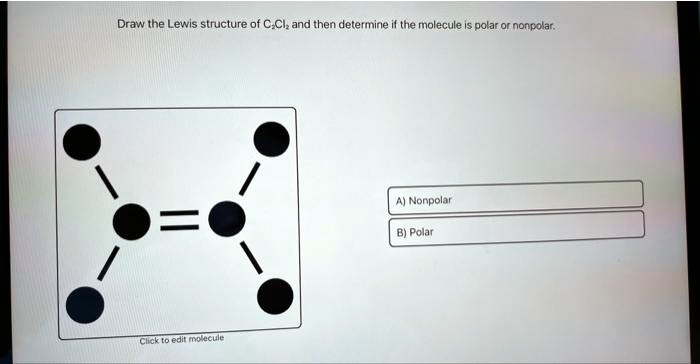
Draw the Lewis structure of C?Cl?, and then determine if the molecule is polar or nonpolar. A) Nonpolar B) Polar
The Correct Answer and Explanation is:
A) Nonpolar
To determine if the molecule C₂Cl₂ (dichloroacetylene) is polar or nonpolar, we must first draw its correct Lewis structure and then analyze its molecular geometry.
1. Drawing the Lewis Structure:
- Count Valence Electrons: First, we find the total number of valence electrons. Carbon (C) is in Group 14 and has 4 valence electrons. Chlorine (Cl) is in Group 17 and has 7 valence electrons.
- Total electrons = (2 Carbon atoms × 4 e⁻) + (2 Chlorine atoms × 7 e⁻) = 8 + 14 = 22 valence electrons.
- Create a Skeletal Structure: Carbon is less electronegative than chlorine, so the two carbon atoms will form the central backbone of the molecule: Cl-C-C-Cl. This initial structure uses 3 single bonds, accounting for 6 electrons.
- Distribute Remaining Electrons: We have 22 – 6 = 16 electrons remaining. We place these as lone pairs on the terminal chlorine atoms to satisfy their octets. Each chlorine needs 6 more electrons, so we add 3 lone pairs to each, using 12 electrons.
- Form Multiple Bonds: We have 16 – 12 = 4 electrons left, which we place on the central carbon atoms. At this stage, the carbons do not have a full octet. To satisfy the octet rule for the carbon atoms, we must form a triple bond between them. The final Lewis structure has a single bond between each chlorine and carbon, and a triple bond between the two carbons (Cl—C≡C—Cl). Each chlorine atom also has three lone pairs.
2. Determining Molecular Polarity:
- Molecular Geometry: We use VSEPR theory to find the molecule’s shape. Each carbon atom is bonded to two other atoms (one C and one Cl) and has no lone pairs. This gives each carbon atom two electron domains, resulting in a linear geometry with 180° bond angles around each carbon. The entire molecule is linear.
- Bond Polarity and Overall Polarity: The electronegativity of chlorine (3.16) is greater than that of carbon (2.55). This difference makes each C-Cl bond polar, with a dipole moment pointing from the carbon toward the more electronegative chlorine. However, the molecule has a symmetrical, linear shape. The two polar C-Cl bonds are positioned on opposite ends of the molecule, pointing in exactly opposite directions. Because these two bond dipoles are equal in magnitude and opposite in direction, they cancel each other out. The net dipole moment for the entire molecule is zero.
Therefore, despite having polar bonds, the symmetrical geometry of C₂Cl₂ makes the molecule nonpolar.