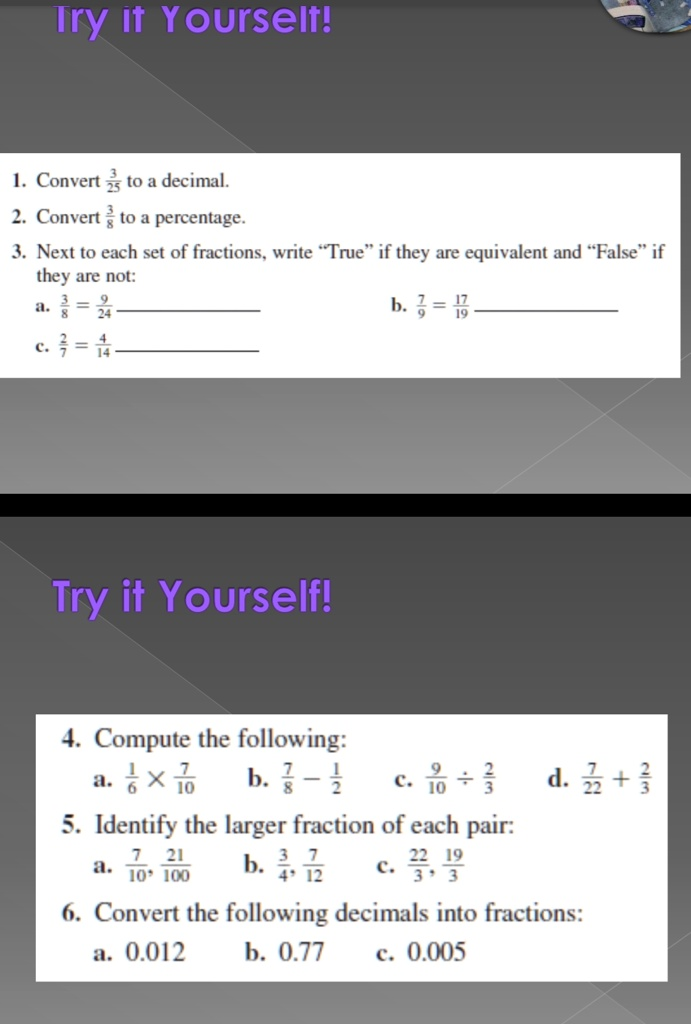
Try it Yourself! 1. Convert \frac{3}{25} to a decimal. 2. Convert \frac{3}{8} to a percentage. 3. Next to each set of fractions, write \text{\”True\” }if they are equivalent and \text{\”False\” }if they are not: a. \frac{3}{8} = \frac{9}{24} _ c. \frac{2}{7} = \frac{4}{14} _ b. \frac{7}{9} = \frac{17}{19} __ Try it Yourself! 4. Compute the following: a. \frac{1}{6} \times \frac{7}{10} b. \frac{7}{8} – \frac{1}{2} c. \frac{9}{10} \div \frac{2}{3} d. \frac{7}{22} + \frac{2}{3} 5. Identify the larger fraction of each pair: a. \frac{7}{10}, \frac{21}{100} b. \frac{3}{4}, \frac{7}{12} c. \frac{22}{3}, \frac{19}{3} 6. Convert the following decimals into fractions: a. 0.012 b. 0.77 c. 0.005
The Correct Answer and Explanation is:
True.”
When computing with fractions (Question 4), each operation has a specific rule. For multiplication, you multiply the numerators together and the denominators together. For division, you invert the second fraction (find its reciprocal) and thenHere are the correct answers and a detailed explanation for the math problems.
Answers:
- 0.12
- 37.5%
- a. True
b. False
c. True - a. 7/60
b. 3/8
c. 27/20 or 1 7/20
d. 65/66 - a. 7/10
b. 3/4
c. 22/3 - a. 3/250
b. 77/100
c. 1/200
Explanation:
These problems cover fundamental operations with fractions and decimals. Here is a breakdown of how to find each solution.
To convert a fraction to a decimal (problem multiply. For addition and subtraction, you must first find a common denominator for both fractions. Once they share a denominator, you simply add or subtract the numerators.
To compare fractions and find the larger one (Question 5), it is easiest to find a common denominator. For 3/4 and 7/12, the common denominator is 12 1), you divide the numerator by the denominator. For 3/25, dividing 3 by 25 gives you 0.12. To convert a fraction to a percentage (problem 2), first convert it to a decimal (. You convert 3/4 to 9/12. Since 9 is greater than 7, 9/3 ÷ 8 = 0.375) and then multiply the result by 100, which gives 312 (or 3/4) is the larger fraction.
Finally, to convert a decimal to a fraction (Question7.5%.
For checking if fractions are equivalent (problem 3), the simplest method is cross-multiplication. You 6), you place the decimal’s digits over the appropriate power of ten. For 0.012, multiply the numerator of the first fraction by the denominator of the second, and vice versa. If the products are equal, the last digit is in the thousandths place, so you write 12/1000. Then, you simplify the fraction by dividing both the numerator and denominator by their greatest common divisor, which is 4, resulting in 3/25 the fractions are equivalent. For 3a, 3 × 24 equals 72, and 8 × 9 also equals 72, so they are equivalent (True). For 3b, 7 × 19 is0. 133, while 9 × 17 is 153. Since these are not equal, the fractions are not equivalent (False).
When computing with fractions (problem 4), you follow specific rules. For multiplication (4a), multiply the numerators together and the denominators together. For subtraction (4b) and addition (4d), you must find a common denominator before you can subtract or add the numerators. For division (4c),