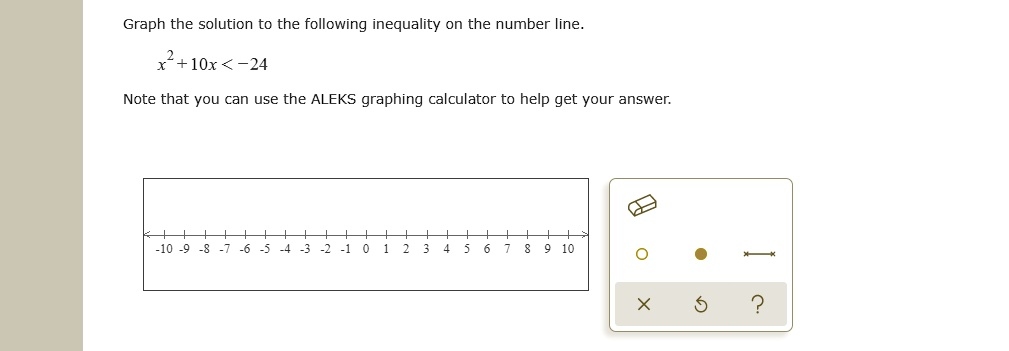
Graph the solution to the following inequality on the number line.
The Correct Answer and Explanation is:
Here is the graph of the solution to the inequality.
Explanation
To find the solution for the quadratic inequality x² + 10x < -24, we first need to rearrange it so that one side is zero. We can accomplish this by adding 24 to both sides of the inequality, which gives us:
x² + 10x + 24 < 0
The next step is to find the critical points of the inequality. We do this by solving the corresponding equation, x² + 10x + 24 = 0. This quadratic equation can be solved by factoring. We need to find two numbers that multiply to 24 and add up to 10. The numbers that fit this criteria are 4 and 6. This allows us to factor the equation as:
(x + 4)(x + 6) = 0
The solutions, or roots, of this equation are x = -4 and x = -6. These are the critical points that divide the number line into three distinct intervals: (-∞, -6), (-6, -4), and (-4, ∞).
Now, we test a value from each interval in the inequality x² + 10x + 24 < 0 to see which interval contains the solutions.
- Test a value less than -6 (e.g., x = -7):
(-7)² + 10(-7) + 24 = 49 – 70 + 24 = 3. Since 3 is not less than 0, this interval is not a solution. - Test a value between -6 and -4 (e.g., x = -5):
(-5)² + 10(-5) + 24 = 25 – 50 + 24 = -1. Since -1 is less than 0, this interval is the solution. - Test a value greater than -4 (e.g., x = 0):
(0)² + 10(0) + 24 = 24. Since 24 is not less than 0, this interval is not a solution.
The solution is the interval (-6, -4), which means -6 < x < -4. To graph this, we place open circles at -6 and -4 to show that these endpoints are not included in the solution, as indicated by the strict inequality symbol (<). Then, we shade the line segment between these two points to represent all the numbers that satisfy the inequality.