Transmitance 1.0 Benzophenone Infrared Spectrum 0.8 0.6 0.4 0.2 0.0 3500 3000 2500 2000 1500 1000 500 Wavenumbers (cm-1)
The Correct Answer and Explanation is:
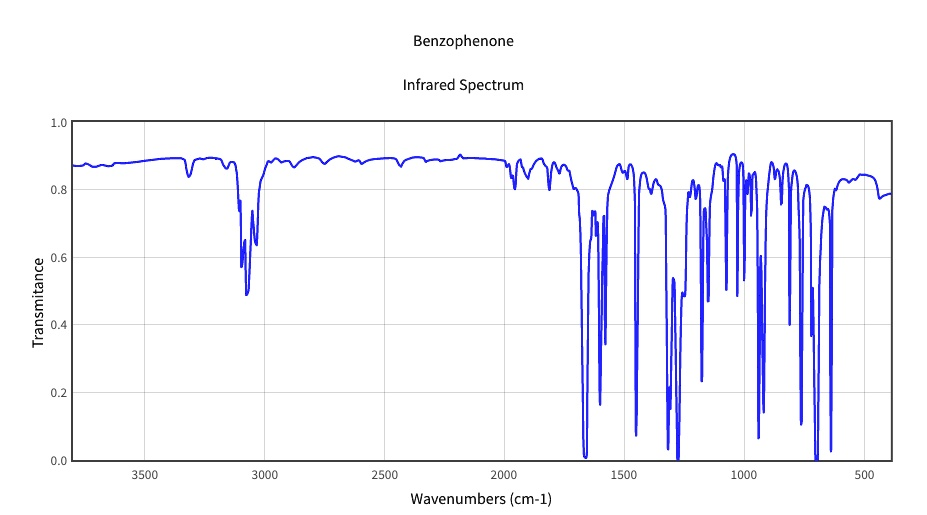
Correct Answer: This is the infrared (IR) spectrum of benzophenone.
Explanation:
The provided image displays the infrared spectrum for benzophenone, a diaryl ketone. The key absorption bands in the spectrum directly correspond to the functional groups present in the benzophenone molecule, (C₆H₅)₂C=O.
First, the region just above 3000 cm⁻¹ shows several sharp, medium intensity peaks, specifically around 3060 cm⁻¹. These absorptions are characteristic of C-H stretching vibrations where the carbon is sp² hybridized, which is consistent with the hydrogen atoms attached to the two aromatic (phenyl) rings. The absence of significant peaks in the 2850-3000 cm⁻¹ range confirms the lack of aliphatic (sp³ hybridized) C-H bonds in the molecule.
The most prominent and diagnostic feature in this spectrum is the very strong, sharp absorption at approximately 1660 cm⁻¹. This peak corresponds to the carbonyl (C=O) stretching vibration. For a simple aliphatic ketone, this peak typically appears around 1715 cm⁻¹. In benzophenone, the carbonyl group is conjugated with both aromatic rings. This conjugation allows for delocalization of the pi electrons, which weakens the C=O double bond and lowers its vibrational frequency, hence its appearance at a lower wavenumber like 1660 cm⁻¹.
In the region from 1600 cm⁻¹ to 1450 cm⁻¹, there are several sharp peaks, including those near 1600 cm⁻¹ and 1450 cm⁻¹. These are characteristic skeletal C=C stretching vibrations within the aromatic rings.

Finally, the fingerprint region below 1500 cm⁻¹ contains complex information, but some features are highly informative. The strong, sharp absorptions around 750 cm⁻¹ and 700 cm⁻¹ are due to C-H out of plane bending vibrations. This specific pattern is a classic indicator of a monosubstituted benzene ring. Since benzophenone consists of two such phenyl groups attached to the carbonyl carbon, these peaks strongly support its structure. The combination of these distinct absorptions provides a definitive spectral fingerprint for benzophenone.