BCC-Chemistry department SHIMADZU 10/6/2017 7:17:33 PM 100 %T 80 30 70 60 4000 3600 pm chem3212 1651.07 1593.20 1573.91 1446.61 1315.45 1276.88 1176.58 1149.57 1076.28 1026.13 999.13 941.26 918.12 813.96 763.81 636.51 3200 2800 2400 2000 1800 1600 1400 1200 1000 800 cm-1 Benzophenona Group 3 1/1
The Correct Answer and Explanation is:
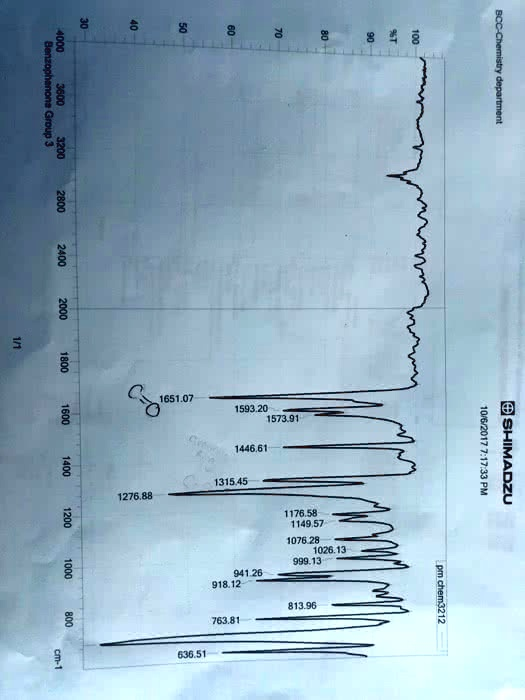
This is an infrared (IR) spectrum for the compound benzophenone. The spectrum displays several characteristic absorption bands that confirm the molecular structure of benzophenone, which consists of a central carbonyl group bonded to two phenyl rings.
The most prominent and diagnostic feature of this spectrum is the very strong, sharp absorption peak at 1651.07 cm⁻¹. This peak is characteristic of a carbonyl (C=O) stretching vibration. For a simple aliphatic ketone, this peak typically appears around 1715 cm⁻¹. The lower frequency observed here is due to conjugation of the carbonyl group with the two aromatic phenyl rings. This resonance effect delocalizes the pi electrons, weakening the C=O double bond and lowering the energy required to stretch it, thus shifting the absorption to a lower wavenumber.
The region just above 3000 cm⁻¹ shows a series of weak, sharp peaks which are characteristic of aromatic C-H stretching vibrations. The absence of any significant peaks in the 2850-2960 cm⁻¹ range indicates the lack of aliphatic C-H bonds, which is consistent with the benzophenone structure.
In the 1600-1450 cm⁻¹ region, there are several distinct peaks at 1593.20 cm⁻¹, 1573.91 cm⁻¹, and 1446.61 cm⁻¹. These absorptions are due to the C=C stretching vibrations within the aromatic rings. The presence of multiple peaks in this area is typical for aromatic compounds.
The fingerprint region, below 1500 cm⁻¹, contains many peaks that are unique to the overall molecule. The strong peak at 1276.88 cm⁻¹ can be assigned to the C-CO-C stretching and bending vibrations of the aryl ketone. Furthermore, the strong absorption bands in the 900-650 cm⁻¹ region correspond to C-H out of plane bending. The peaks at 763.81 cm⁻¹ and others in this area are indicative of a monosubstituted benzene ring, which is the substitution pattern for both phenyl groups in benzophenone. The collective evidence from these absorptions strongly confirms the sample’s identity.