-uria The word root means phosphate or phosphorus. -phag- The word root means feeding or eating. -tropic The word root means blood or lymph vessels. angio- phospho- The word root means urine. The word root means attracted specifically to the specified organ or tissue.
The Correct Answer and Explanation is:
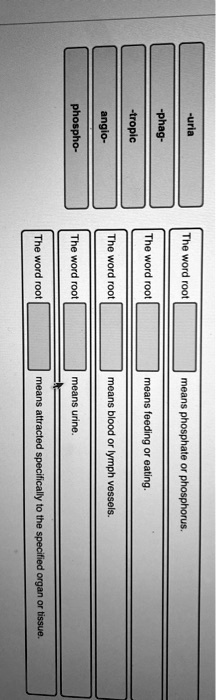
Here are the correct matches for the word roots and their meanings based on the image:
The word root phospho- means phosphate or phosphorus.
The word root -phag- means feeding or eating.
The word root angio- means blood or lymph vessels.
The word root -uria means urine.
The word root -tropic means attracted specifically to the specified organ or tissue.
Explanation
Understanding medical and biological terminology often involves breaking down words into their component parts: prefixes, roots, and suffixes. The exercise provides five such word roots and asks to match them with their definitions.
phospho- is a prefix that directly relates to the chemical element phosphorus and its common compound, phosphate. It originates from the Greek word phosphoros, meaning “light-bringing,” which was the ancient name for the planet Venus and later applied to the element due to its luminescence. In science, this prefix is used in terms like phospholipid (a key component of cell membranes) and phosphorylation (the process of adding a phosphate group to a molecule), both fundamental concepts in biochemistry.
-phag- is a root derived from the Greek word phagein, meaning “to eat.” It is used to form words related to eating, consumption, or engulfing. A common example is a phagocyte, which is a type of cell that engulfs and digests foreign particles or cellular debris. The medical term dysphagia refers to difficulty in swallowing or eating.
angio- is a prefix from the Greek word angeion, meaning “vessel” or “container.” In a medical context, it specifically refers to vessels that carry fluid, such as blood vessels (arteries, veins, capillaries) or lymphatic vessels. For instance, an angiogram is an X-ray image of blood vessels, and angioplasty is a surgical procedure to unblock them.
-uria is a suffix used to denote a condition related to urine. It comes from the Greek word ouron, meaning “urine.” This suffix is frequently seen in medical diagnoses, such as hematuria (blood in the urine), polyuria (excessive production of urine), and proteinuria (the presence of excess protein in the urine).
-tropic is a suffix originating from the Greek word tropos, meaning “a turn” or “attraction.” In biology, it describes an affinity for, or an action directed toward, a specific target. For example, a neurotropic virus is one that preferentially infects nervous tissue. Similarly, gonadotropic hormones are hormones that are attracted to and act upon the gonads (testes or ovaries).