Anna Scientist Kathod Thinking: Testing the Safety of Bisphenol A What are you doing? Hutiana has designed an experiment to test her hypothesis about the effects of BPA on mice. They administered daily doses of BPA to these mice and observed any abnormalities that occur during BPA exposure. The labels below can be dragged to identify the components of Hunt’s experiment. Labels may be used once, more than once, or not at all. Dosage (ng/g) BPA Dosage 20 ng/g BPA Dosage 40 ng/g BPA Dosage 100 ng/g BPA Date Side Adequate Fun Even Control Jade Wannuta Gaul Kepeleantmanns Cols Drop Lrolm Inded nileina Vnst Dosage BPA administered (ng/g) Duration The length of time over which mice were exposed to BPA (days) Downy The percentage of mice displaying genetic abnormalities (on F) Submit Best Answer
The Correct Answer and Explanation is:
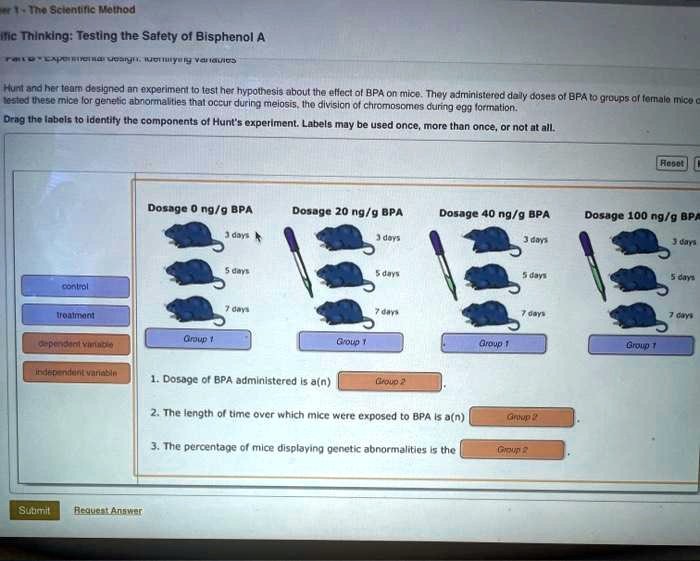
Here is the correct identification for each component of the experiment:
- Dosage of BPA administered is a(n) independent variable.
- The length of time over which mice were exposed to BPA is a(n) independent variable.
- The percentage of mice displaying genetic abnormalities is the dependent variable.
Explanation
In scientific research, understanding the roles of different variables is fundamental to designing a valid experiment. This experiment on the effects of Bisphenol A (BPA) on mice clearly illustrates these concepts.
An independent variable is the factor that a scientist intentionally changes or manipulates to test its effects. The scientist has direct control over this variable. In this study, the researchers are systematically altering two factors. The first is the “Dosage of BPA administered.” They are giving different groups of mice specific, predetermined amounts of BPA (0, 20, 40, and 100 ng/g) to see how each dosage level affects them. The second independent variable is “The length of time over which mice were exposed.” The experiment is set up to observe the mice after 3, 5, and 7 days. Because the researchers are controlling both the BPA concentration and the duration of exposure, both are considered independent variables.
The dependent variable is what the researcher measures as the outcome of the experiment. Its value is expected to be influenced by, or depend on, the changes made to the independent variable. In this case, the “percentage of mice displaying genetic abnormalities” is the dependent variable. The hypothesis is that this percentage will change based on the dose of BPA and the length of exposure. The scientists observe and record this outcome to see if their hypothesis is supported.
Additionally, the group of mice receiving “Dosage 0 ng/g BPA” serves as the control group. This group does not receive the chemical being tested and acts as a baseline for comparison. The groups receiving 20, 40, and 100 ng/g of BPA are the treatment groups. By comparing the genetic abnormalities in the treatment groups to the control group, the scientists can more confidently conclude that any observed differences are due to the BPA.