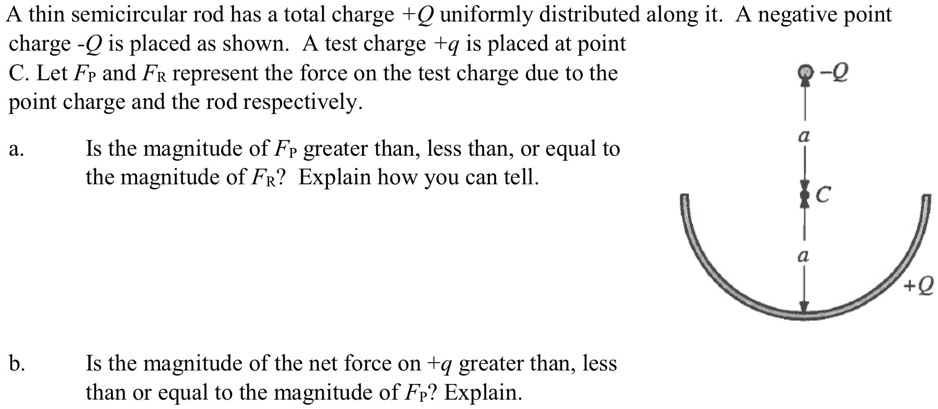
A thin semicircular rod has a total charge +Q uniformly distributed along it. negative point charge -Q is placed as shown: A test charge +q is placed at point C. Let Fp and FR represent the force on the test charge due to the point charge and the rod respectively Is the magnitude of Fp greater than; less than, Or equal to the magnitude of Fr? Explain how You can tell: Is the magnitude of the net force on +q greater than, less than or equal to the magnitude of Fp? Explain.
The Correct Answer and Explanation is:
Here are the answers to the questions.
a. Is the magnitude of Fp greater than, less than, or equal to the magnitude of Fr? Explain how you can tell.
The magnitude of Fp is greater than the magnitude of Fr.
b. Is the magnitude of the net force on +q greater than, less than or equal to the magnitude of Fp? Explain.
The magnitude of the net force on +q is greater than the magnitude of Fp.
Explanation
a. Comparison of Fp and Fr
The force Fp is exerted by the point charge -Q on the test charge +q. According to Coulomb’s Law, its magnitude is Fp = k|(-Q)(+q)|/a² = kQq/a². This force is due to a charge that is entirely concentrated at a single point, a distance ‘a’ away.
The force Fr is exerted by the semicircular rod with total charge +Q. While the total magnitude of the source charge is the same (Q) and every point on the rod is the same distance ‘a’ from the test charge, the charge is distributed along an arc. The force from each small segment of the rod is a vector pointing away from that segment. Because of the semicircular arrangement, the horizontal components of these force vectors cancel each other out by symmetry. Only the vertical components of the forces add together to produce the net force Fr. This vector cancellation means that the total force from the distributed charge is weaker than it would be if all the charge were concentrated at a single point. Therefore, the magnitude of Fp is greater than the magnitude of Fr.
b. Comparison of the Net Force and Fp
The net force on the test charge +q is the vector sum of the individual forces: Fnet = Fp + Fr. To determine the magnitude of the net force, we must consider the direction of each force.
- Fp: The force on the positive test charge +q from the negative point charge -Q is attractive. Thus, Fp points upward.
- Fr: The force on the positive test charge +q from the positively charged rod +Q is repulsive. By symmetry, the net repulsive force from the semicircle points directly away from the arc, along the axis of symmetry. Thus, Fr also points upward.
Since both Fp and Fr point in the same direction, the magnitude of their vector sum is simply the sum of their individual magnitudes: |Fnet| = |Fp| + |Fr|. Because Fr is a force from a charge distribution, its magnitude is a positive value. Adding this positive value to |Fp| results in a net force that is greater than |Fp| alone.