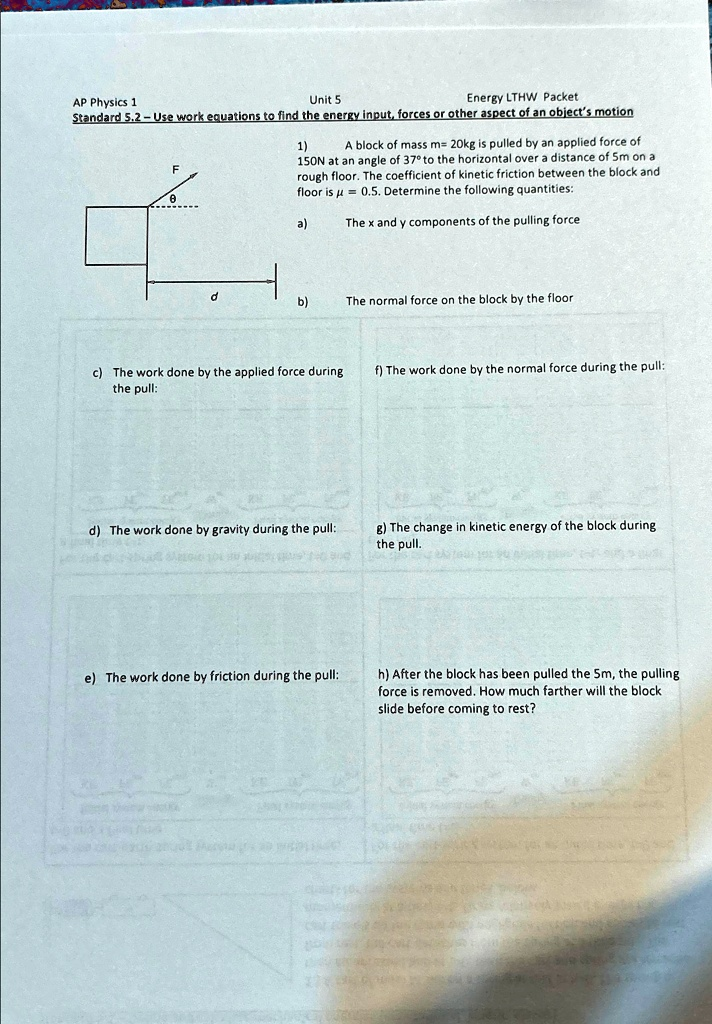
Unit 5 Energy LTHW Packet AP Physics 1 Standard 5.2—Use work equations to find the energy input, forces or other aspect of an object’s motion 1) A block of mass m = 20kg is pulled by an applied force of 150N at an angle of 37° to the horizontal over a distance of 5m on a rough floor. The coefficient of kinetic friction between the block and floor is µ = 0.5. Determine the following quantities: a) The x and y components of the pulling force b) The normal force on the block by the floor c) The work done by the applied force during the pull: d) The work done by gravity during the pull: e) The work done by friction during the pull: f) The work done by the normal force during the pull: g) The change in kinetic energy of the block during the pull. h) After the block has been pulled the 5m, the pulling force is removed. How much farther will the block slide before coming to rest?
The Correct Answer and Explanation is:
Here are the solutions to the physics problem, followed by a detailed explanation.
Correct Answers:
a) Fx = 120 N, Fy = 90 N
b) The normal force is 106 N.
c) The work done by the applied force is 600 J.
d) The work done by gravity is 0 J.
e) The work done by friction is -265 J.
f) The work done by the normal force is 0 J.
g) The change in kinetic energy is 335 J.
h) The block will slide 3.42 meters farther.
Explanation:
This problem is solved using principles of forces, work, and the work-energy theorem. We use the common approximations for a 37-degree angle (cos(37°) ≈ 0.8, sin(37°) ≈ 0.6) and g = 9.8 m/s².
a) First, the applied force is broken into its horizontal (x) and vertical (y) components. The x-component is Fx = F * cos(37°) = 150 N * 0.8 = 120 N. The y-component is Fy = F * sin(37°) = 150 N * 0.6 = 90 N.
b) To find the normal force, we analyze the vertical forces. Since the block does not accelerate vertically, the net vertical force is zero. The upward forces (normal force N and the upward pull Fy) must balance the downward force of gravity (Fg = m*g = 20 kg * 9.8 m/s² = 196 N). So, N + Fy = Fg, which gives N = 196 N – 90 N = 106 N.
c, d, f) Work is calculated as W = F * d * cos(θ), where θ is the angle between the force and displacement. The work done by the applied force is W_app = Fx * d = 120 N * 5 m = 600 J. The work done by gravity and the normal force are both zero because these forces are perpendicular to the horizontal displacement (cos(90°) = 0).
e) The work done by friction is negative because friction opposes motion. First, the friction force is f_k = µ * N = 0.5 * 106 N = 53 N. Then, the work done is W_friction = -f_k * d = -53 N * 5 m = -265 J.
g) The work-energy theorem states that the net work done equals the change in kinetic energy (ΔK = W_net). The net work is the sum of all individual works: W_net = 600 J + 0 J + 0 J – 265 J = 335 J. Thus, the block’s kinetic energy increases by 335 J.
h) After the pull, the block’s initial kinetic energy for this phase is 335 J. The pulling force is gone, so the normal force now equals gravity (N_new = 196 N). The new friction force is f_k_new = µ * N_new = 0.5 * 196 N = 98 N. This friction does negative work to bring the block to rest (final kinetic energy is 0). Using the work-energy theorem again: W_friction = ΔK, so -f_k_new * d_slide = 0 – 335 J. This gives -98 * d_slide = -335, and the sliding distance is d_slide = 335 / 98 ≈ 3.42 m.