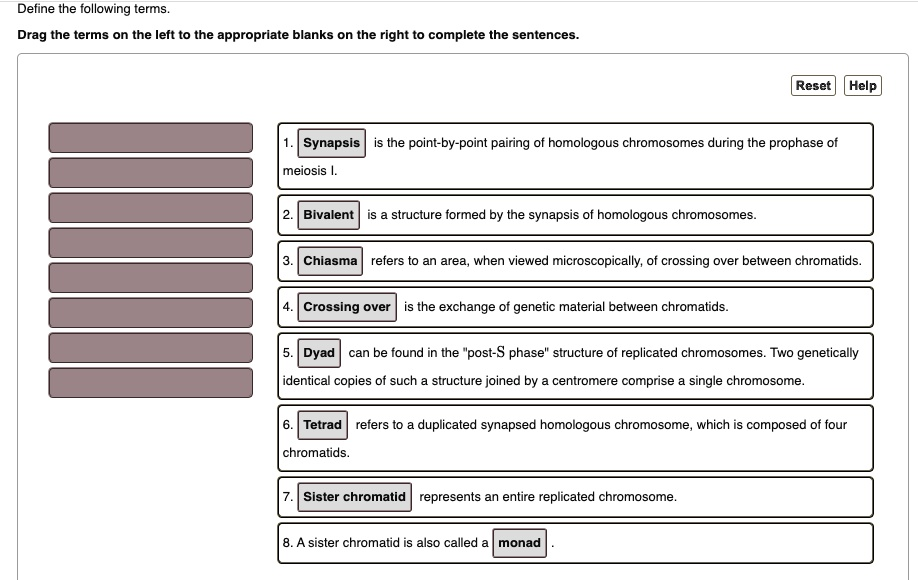
Define the following terms. Drag the terms on the left to the appropriate blanks on the right to complete the sentences. Synapsis is the point-by-point pairing of homologous chromosomes during the prophase of meiosis. Bivalent is a structure formed by the synapsis of homologous chromosomes. Chiasma refers to an area when viewed microscopically; of crossing over between chromatids. Crossing over is the exchange of genetic material between chromatids. Dyad can be found in the “post-S phase structure of replicated chromosomes. Two genetically identical copies of such structure joined by centromere comprise a single chromosome. Tetrad refers to a duplicated synapsed homologous chromosome, which is composed of four chromatids. Sister chromatid represents an entire replicated chromosome. A sister chromatid is also called a monad.
The Correct Answer and Explanation is:
Based on the provided image, here are the correct term-definition pairings:
- Synapsis is the point-by-point pairing of homologous chromosomes during the prophase of meiosis I.
- Bivalent is a structure formed by the synapsis of homologous chromosomes.
- Chiasma refers to an area, when viewed microscopically, of crossing over between chromatids.
- Crossing over is the exchange of genetic material between chromatids.
- Dyad can be found in the “post-S phase” structure of replicated chromosomes. Two genetically identical copies of such a structure joined by a centromere comprise a single chromosome.
- Tetrad refers to a duplicated synapsed homologous chromosome, which is composed of four chromatids.
- Sister chromatid represents an entire replicated chromosome.
- A sister chromatid is also called a monad.
Explanation
These terms describe the critical structures and events involving chromosomes during meiosis, the process of cell division that produces gametes like sperm and eggs.
The process begins in prophase I. Here, homologous chromosomes, one inherited from each parent, pair up very precisely along their lengths. This pairing process is called synapsis. The resulting structure of two paired homologous chromosomes is known as a bivalent. Since each of these homologous chromosomes has already replicated its DNA to form two identical sister chromatids, the bivalent structure actually contains four chromatids in total. For this reason, it is also referred to as a tetrad.
While the homologous chromosomes are paired in a tetrad, a crucial event called crossing over occurs. This is the physical exchange of genetic material between non-sister chromatids, which creates new combinations of alleles and increases genetic diversity. The visible, X-shaped point where this exchange takes place is called a chiasma.
The terms dyad, monad, and sister chromatid describe the chromosome’s structure. After DNA replication but before cell division, a single chromosome consists of two identical copies joined at a centromere. This X-shaped structure is a dyad. Each of the two identical copies is a sister chromatid. When the sister chromatids separate during meiosis II (or mitosis), each one becomes an individual, unreplicated chromosome, which is then called a monad. Therefore, the terms monad and sister chromatid can refer to the same single-chromatid structure. It is important to note that the definition provided for sister chromatid (number 7) is slightly imprecise; a sister chromatid is one half of a replicated chromosome, while a dyad is the entire replicated structure.