The Correct Answer and Explanation is:
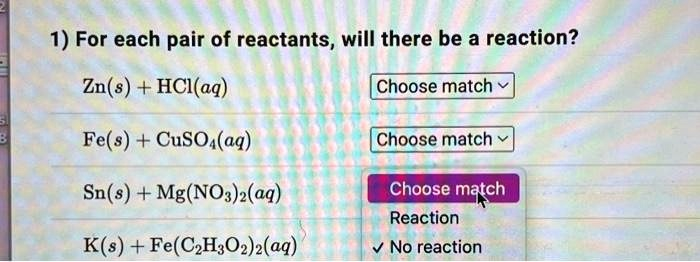
Here are the correct answers for each pair of reactants:
- Zn(s) + HCl(aq): Reaction
- Fe(s) + CuSO₄(aq): Reaction
- Sn(s) + Mg(NO₃)₂(aq): No reaction
- K(s) + Fe(C₂H₃O₂)₂(aq): Reaction
Explanation
To determine if these single displacement reactions will occur, we must consult the activity series of metals. This series ranks metals (and hydrogen) based on their reactivity. A more reactive element, positioned higher on the series, will displace a less reactive element from a compound in an aqueous solution.
For the first reaction, Zn(s) + HCl(aq), we compare zinc (Zn) to hydrogen (H). On the activity series, zinc is more reactive than hydrogen. Because zinc is higher on the list, it has the ability to displace hydrogen from the acid. This reaction proceeds to form zinc chloride (ZnCl₂) and hydrogen gas (H₂).
In the second case, Fe(s) + CuSO₄(aq), we compare iron (Fe) and copper (Cu). Iron is more reactive than copper and sits above it in the activity series. Therefore, iron will displace copper from the copper(II) sulfate solution, resulting in the formation of iron(II) sulfate (FeSO₄) and solid copper (Cu).
The third reaction is Sn(s) + Mg(NO₃)₂(aq). Here, we compare tin (Sn) to magnesium (Mg). Magnesium is a highly reactive alkaline earth metal and is located much higher on the activity series than tin. Since tin is less reactive, it cannot displace magnesium from the magnesium nitrate solution. Consequently, there is no reaction.
Finally, for K(s) + Fe(C₂H₃O₂)₂(aq), we compare potassium (K) and iron (Fe). Potassium is an alkali metal and is at the very top of the activity series, making it extremely reactive. It is far more reactive than iron. As a result, potassium will readily displace iron from the iron(II) acetate solution, leading to a vigorous reaction that forms potassium acetate and solid iron.