Grass \rightarrow Grasshopper \rightarrow Mouse \rightarrow Owl
The Correct Answer and Explanation is:
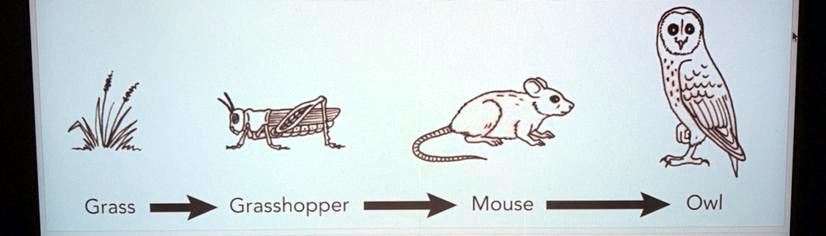
The image displays a food chain, which illustrates the flow of energy in an ecosystem. The correct sequence and roles are as follows:
- Producer: Grass
- Primary Consumer: Grasshopper
- Secondary Consumer: Mouse
- Tertiary Consumer: Owl
Explanation
This image shows a classic example of a food chain, a linear sequence that demonstrates how energy is transferred from one living organism to another. Each arrow in the diagram represents the direction of this energy flow, essentially meaning “is eaten by”. Every link in the chain is essential for the stability of this small ecosystem.
The food chain begins with the grass, which is a producer. Producers are organisms that create their own food, typically through photosynthesis, using energy from the sun. They form the foundation of the food chain, representing the first trophic level.
Next is the grasshopper, which is the primary consumer. As a herbivore, it gets its energy by eating the producer (the grass). The grasshopper occupies the second trophic level.
The mouse then eats the grasshopper, making it the secondary consumer. Secondary consumers are organisms that eat primary consumers. In this specific chain, the mouse is acting as a carnivore, though mice can also be omnivores. The mouse represents the third trophic level.
Finally, the owl eats the mouse. This places the owl at the top of this particular food chain as the tertiary consumer, an animal that feeds on secondary consumers. It occupies the fourth trophic level. In this context, the owl can be considered an apex predator since nothing in this chain preys upon it.
The transfer of energy between these levels is inefficient; only about 10% of the energy from one level is incorporated into the next. The remaining 90% is used for metabolic processes or lost as heat. This principle explains why food chains are typically short. The removal of any single organism, like the mouse, would have significant consequences, disrupting the flow of energy and affecting the populations of both the grasshoppers and the owls.