Grass \rightarrow Grasshopper \rightarrow Mouse \rightarrow Owl
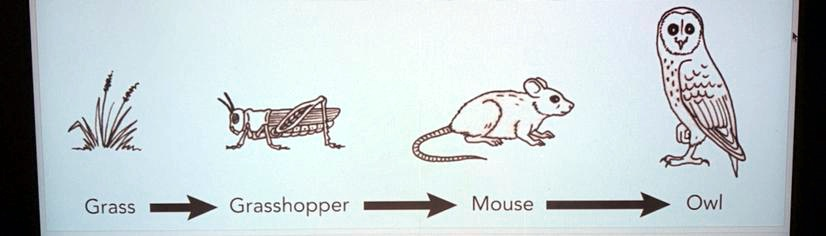
The Correct Answer and Explanation is:
The image displays a classic example of a food chain, which illustrates the flow of energy through a series of organisms in an ecosystem. Each organism occupies a specific position in the chain, known as a trophic level.
Here is a breakdown of the roles of each organism in this food chain:
1. Grass (Producer):
The food chain begins with grass. Grass is a producer, or an autotroph, meaning it creates its own food. Using energy from the sun through a process called photosynthesis, it converts sunlight, water, and carbon dioxide into chemical energy in the form of glucose. Producers form the first trophic level and are the foundation of almost every ecosystem, providing the initial energy that supports all other life forms.
2. Grasshopper (Primary Consumer):
The grasshopper eats the grass. This makes it a primary consumer, or an herbivore. Primary consumers are organisms that feed on producers. By eating the grass, the grasshopper obtains the energy that the grass originally captured from the sun. The grasshopper represents the second trophic level in this chain.
3. Mouse (Secondary Consumer):
The mouse eats the grasshopper. This positions the mouse as a secondary consumer. Secondary consumers are organisms that eat primary consumers. In this specific chain, the mouse is acting as a carnivore (specifically, an insectivore) because it is eating another animal. It obtains energy by consuming the grasshopper. The mouse occupies the third trophic level.
4. Owl (Tertiary Consumer):
The owl eats the mouse. This makes the owl a tertiary consumer, which is an organism that feeds on secondary consumers. As the final organism in this particular sequence, the owl is also considered an apex predator, meaning it has no natural predators in this chain. The owl is at the fourth trophic level.
The arrows in the diagram are crucial as they indicate the direction of energy transfer. Energy flows from the grass to the grasshopper, then to the mouse, and finally to the owl. However, this transfer is inefficient; a significant amount of energy is lost at each level, primarily as heat during metabolic activities. This loss of energy limits the length of most food chains.