The Correct Answer and Explanation is:
Of course. Here is the correct answer and a detailed explanation.
Correct Answer:
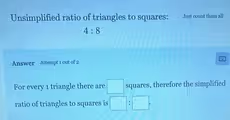
For every 1 triangle there are 2 squares, therefore the simplified ratio of triangles to squares is 1 : 2.
Explanation
The problem asks you to simplify a ratio and understand what it represents. A ratio is a way to compare two or more quantities. In this case, we are comparing the number of triangles to the number of squares.
The starting point is the unsimplified ratio of 4:8. This means for every group of 4 triangles, there is a corresponding group of 8 squares. The task is to break this down into its simplest form.
Part 1: Finding the Unit Ratio
The first sentence asks, “For every 1 triangle there are ____ squares”. This is asking for a unit ratio, where one of the quantities is reduced to 1. To find this, we need to determine how many squares correspond to a single triangle.
We start with the ratio 4:8. To change the “triangles” side from 4 to 1, we must divide it by 4. A fundamental rule of ratios is that to keep the relationship proportional, you must perform the same mathematical operation on both sides.
Therefore, we also divide the “squares” side of the ratio by 4.
- Triangles: 4 ÷ 4 = 1
- Squares: 8 ÷ 4 = 2
This calculation shows that for every 1 triangle, there are 2 squares. So, the number that fills the first blank is 2.
Part 2: Simplifying the Ratio
The second part asks for the simplified ratio. Simplifying a ratio is like simplifying a fraction; you want to express it using the smallest possible whole numbers. To do this, you find the greatest common factor (GCF) of both numbers in the ratio and then divide both numbers by the GCF.
The numbers in our ratio are 4 and 8. The factors of 4 are 1, 2, and 4. The factors of 8 are 1, 2, 4, and 8. The greatest factor they have in common is 4.
Now, we divide both parts of the original ratio by the GCF, which is 4:
- Triangles: 4 ÷ 4 = 1
- Squares: 8 ÷ 4 = 2
This gives us the simplified ratio of 1:2. This is the simplest whole-number way to express the relationship between the triangles and squares.