The Correct Answer and Explanation is:
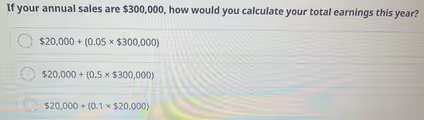
The correct answer is $20,000 + (0.05 x $300,000).
This formula accurately represents a common compensation structure in sales roles, which typically consists of a fixed base salary combined with a variable commission based on performance. To understand why this is the correct choice, let’s break down the components of the calculation and analyze the logic behind each option provided.
The correct formula, $20,000 + (0.05 x $300,000), can be deconstructed into two parts. The first part is the $20,000. This figure represents the annual base salary. It is a guaranteed, fixed amount of income that the individual earns regardless of their sales volume. The second part, (0.05 x $300,000), calculates the commission earned. Commission is a performance based incentive. In this case, the commission rate is 0.05, or 5%, which is a realistic rate in many industries. This percentage is correctly multiplied by the total annual sales of $300,000 to determine the commission amount. Adding the base salary to the earned commission gives you the total earnings for the year. This structure directly links higher earnings to successful sales performance, which is the fundamental purpose of a sales commission plan.
Now let’s examine why the other two options are incorrect. The second option, $20,000 + (0.5 x $300,000), follows the same logical structure of base salary plus commission. However, it uses a commission rate of 0.5, or 50%. A 50% commission rate is exceptionally high and financially impractical for almost any business, as it would mean paying out half of all revenue to the salesperson. While mathematically possible, it is not a realistic business scenario.
The third option, $20,000 + (0.1 x $20,000), is fundamentally flawed in its logic. It correctly identifies the
20,000basesalarybutthencalculatestheadditionalearningsbytakingapercentage(0.1or1020,000basesalarybutthencalculatestheadditionalearningsbytakingapercentage(0.1or10300,000` in annual sales. Therefore, it cannot be the correct method for calculating total earnings based on sales performance.