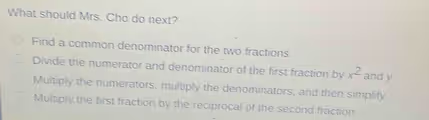
The Correct Answer and Explanation is:
The correct answer is: Multiply the first fraction by the reciprocal of the second fraction.
Here is a detailed explanation:
This step is the fundamental and correct procedure for dividing two fractions or rational expressions. The process of dividing by a fraction is mathematically defined as multiplying by its reciprocal. A reciprocal is what you get when you invert a fraction, meaning you swap the numerator and the denominator. This rule is often taught using the mnemonic “Keep, Change, Flip.”
Let’s break down this method. If Mrs. Cho is faced with a problem such as (fraction 1) ÷ (fraction 2), she should:
- Keep the first fraction exactly as it is.
- Change the division symbol (÷) to a multiplication symbol (×).
- Flip the second fraction to its reciprocal. For example, if the second fraction is a/b, its reciprocal is b/a.
After performing these three actions, the original division problem is transformed into a multiplication problem, which can then be solved by multiplying the numerators together and the denominators together.
Let’s consider why the other options are incorrect. Finding a common denominator is the standard method for adding or subtracting fractions, not for dividing them. Multiplying the numerators and denominators directly would be the correct step if the problem were multiplication to begin with, but it is not the first step for a division problem. Finally
, while simplifying a single fraction is a useful skill, it is not the main operational step required to solve the division between two separate fractions. Therefore, the essential first step to correctly solve the problem is to multiply the first fraction by the reciprocal of the second.