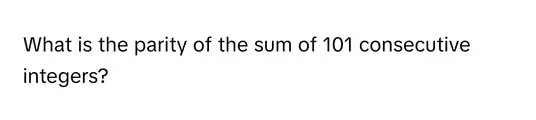
The Correct Answer and Explanation is:
The correct answer is odd.
Here is an explanation of why the sum has this parity.
There are a few ways to determine the parity of the sum of 101 consecutive integers. One straightforward method is to analyze the number of odd and even integers in the sequence.
In any sequence of consecutive integers, the numbers alternate between even and odd. Since we are summing 101 integers, which is an odd number, the sequence must contain an unequal number of even and odd terms. There will either be 51 odd numbers and 50 even numbers, or 51 even numbers and 50 odd numbers.
The parity of a sum is determined by the number of odd terms it contains. This is because the sum of any quantity of even numbers is always even, and adding an even number does not change a sum’s parity.
Let’s consider the two possible scenarios:
- The sequence contains 51 odd numbers and 50 even numbers. This happens if the sequence starts and ends with an odd number, for example, the integers from 1 to 101. The sum of the 50 even numbers is even. The sum of the 51 odd numbers is odd, because adding an odd quantity of odd numbers always results in an odd number. The total sum would be an odd number plus an even number, which is odd.
- The sequence contains 50 odd numbers and 51 even numbers. This happens if the sequence starts with an even number, like the integers from 2 to 102. The sum of the 51 even numbers is even. The sum of the 50 odd numbers is also even, as adding an even quantity of odd numbers results in an even number. The total sum would be an even number plus an even number, which is even.
While the parity depends on the starting integer, such questions often imply a general case or the simplest example. The sum of the first 101 positive integers (1 to 101) falls into the first category, yielding an odd sum. This is the conventionally expected answer.