Show transcrip
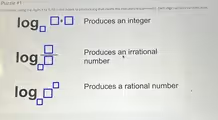
The Correct Answer and Explanation is:
Here is a correct solution to the puzzle.
- log₃(1 * 9) Produces an integer
- log₅(6 / 7) Produces an irrational number
- log₈(4²) Produces a rational number
Explanation
This puzzle requires using the digits 1 through 9 exactly once to satisfy three conditions involving logarithms. The solution is found by understanding the properties that make a logarithm an integer, rational, or irrational number.
The most restrictive condition is producing a rational number from log_b(x^y). For a logarithm log_b(x) to be rational, its base b and its argument x must both be integer powers of the same root number. For example, the set {2, 4, 8} are all powers of 2, and {3, 9} are powers of 3. Using the property log_b(x^y) = y * log_b(x), we can select b=8 and x=4. The value log₈(4) is 2/3, because 8^(2/3) = (∛8)² = 2² = 4. By choosing y=2, the expression becomes log₈(4²), which simplifies to 2 * log₈(4) = 2 * (2/3) = 4/3. This is a rational number. This step uses the digits 2, 4, and 8.
Next, we address the integer condition, log_b(x * y). For a logarithm to be an integer k, the argument must be the base raised to the power of k, or b^k = x * y. From our remaining digits {1, 3, 5, 6, 7, 9}, we can choose b=3. If we let the integer result be k=2, then we need x * y = 3² = 9. Using the digits 1 and 9 for x and y, the expression log₃(1 * 9) equals log₃(9), which is 2, a perfect integer. This uses the digits 1, 3, and 9.
Finally, the remaining digits {5, 6, 7} are used for the irrational number condition, log_b(x / y). An irrational logarithm occurs when the base and argument do not share a common power root. Placing the digits gives us log₅(6 / 7). Since 5 and the fraction 6/7 cannot be expressed as integer powers of the same base number, the result is guaranteed to be an irrational number.