The Correct Answer and Explanation is:
Here are the correct answers and explanations for the questions provided in the image.
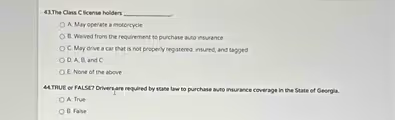
Question 43: The Class C license holders _________.
Correct Answer: E. None of the above
A Class C license is the most common type of driver’s license, allowing individuals to operate standard passenger cars, vans, and small trucks for non commercial use. The options presented are all incorrect for a holder of this license.
Option A, operating a motorcycle, is incorrect because driving a motorcycle requires a separate Class M license or a motorcycle endorsement on an existing license. A Class C license does not grant this privilege.
Option B states that license holders are waived from the requirement to purchase auto insurance. This is false. All states, including Georgia, have financial responsibility laws that mandate drivers carry a minimum amount of auto insurance to operate a vehicle legally.
Option C suggests a license holder may drive a car that is not properly registered, insured, and tagged. This is also false and describes illegal actions. Driving an unregistered or uninsured vehicle on public roads is against the law and carries significant penalties, regardless of the driver’s license class.
Since options A, B, and C are all incorrect statements about the privileges and responsibilities of a Class C license holder, the correct answer is E, None of the above.
Question 44: TRUE or FALSE? Drivers are required by state law to purchase auto insurance coverage in the State of Georgia.
Correct Answer: A. True
This statement is true. The State of Georgia has a compulsory auto insurance law. This means that to legally operate a motor vehicle on Georgia’s roads, drivers must maintain continuous liability insurance coverage. The purpose of this law is to ensure that drivers are financially responsible for any damage or injuries they may cause in an at fault accident.
Georgia law specifies minimum liability coverage limits that every policy must meet. Driving without this mandatory insurance is a serious offense that can result in fines, suspension of your driver’s license and vehicle registration, and other penalties. The state enforces this through an electronic database that tracks the insurance status of registered vehicles.