The Correct Answer and Explanation is:
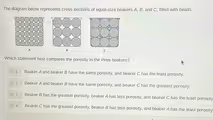
The correct statement is that Beaker A and beaker B have the same porosity, and beaker C has the least porosity.
Porosity is a scientific measure of the empty or void space within a material. It is calculated as the ratio of the volume of these empty spaces to the total volume of the material, often expressed as a percentage. The question tests the understanding of how particle size and sorting affect this property.
The diagram illustrates a fundamental principle. Both beaker A and beaker B contain well-sorted materials. This means the beads within each respective beaker are uniform in size. Beaker A has small beads, and beaker B has large beads. A common misconception is that smaller particles lead to lower porosity. However, when particles are well-sorted and packed in a similar regular arrangement, the particle size itself does not influence the overall porosity. While the individual pore spaces between the large beads in beaker B are bigger, the total volume of pore space relative to the total volume of the beaker is the same as in beaker A. The smaller beads in A have more numerous but much smaller pores, and the ratio of void space to solid space remains constant. Therefore, beaker A and beaker B have virtually identical porosities.
Beaker C, on the other hand, represents a poorly sorted material, as it contains a mixture of large and small beads. In this scenario, the smaller beads fill in the large pore spaces that would otherwise exist between the larger beads. This infilling process significantly reduces the total volume of empty space available within the beaker. Consequently, the overall porosity of the material in beaker C is much lower than in the well-sorted examples of beakers A and B. The presence of varied particle sizes allows for more efficient packing, leaving less room for voids.