The Correct Answer and Explanation is:
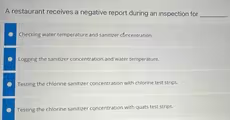
The correct answer is: Testing the chlorine sanitizer concentration with quats test strips.
This action would result in a negative inspection report because it demonstrates a fundamental failure in proper food safety procedures. Sanitizers used in food service, such as chlorine and Quaternary Ammonium Compounds, commonly known as quats, are distinct chemical solutions. Each type requires a specific and corresponding test kit to accurately measure its concentration in parts per million (PPM).
Test strips are designed with chemical reagents that react only with the specific sanitizer they are intended for. A chlorine test strip will react to chlorine, and a quats test strip will react to quaternary ammonium. Using a quats test strip to measure a chlorine solution will yield a completely inaccurate reading, making it impossible for staff to verify the sanitizer’s effectiveness.
The concentration of a sanitizer must be maintained within a specific range to be both safe and effective. If the solution is too weak, it will not properly kill harmful bacteria and viruses like Salmonella or E. coli, creating a significant risk of foodborne illness. Conversely, if the solution is too strong, it can leave a toxic chemical residue on food contact surfaces, posing a chemical contamination hazard to customers.
A health inspector observing a food handler using the wrong type of test strip would immediately identify this as a critical violation. It shows a lack of training and a failure in the restaurant’s system for ensuring food safety. The other answer choices describe correct or required actions. Checking and logging sanitizer concentration are mandatory tasks, and testing chlorine with the appropriate chlorine test strips is the correct procedure. Only the use of mismatched testing equipment represents a clear and reportable violation.