The Correct Answer and Explanation is:
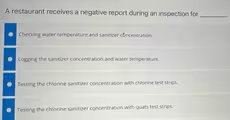
The correct answer is: Testing the chlorine sanitizer concentration with quats test strips.
A restaurant would receive a negative report for this action because it demonstrates a fundamental misunderstanding of chemical safety and sanitation procedures. In the food service industry, maintaining proper sanitizer concentration is a critical control point for preventing foodborne illness. There are several types of chemical sanitizers approved for use, with the most common being chlorine, quaternary ammonium compounds (quats), and iodine.
Each sanitizer type requires a specific test strip designed to measure its unique chemical properties. Chlorine test strips react to the presence and concentration of chlorine, while quats test strips are designed to measure the concentration of quaternary ammonium compounds. Using the wrong test strip will produce an invalid and meaningless result.
If a health inspector observes an employee using quats test strips to measure a chlorine based sanitizer, it is a significant violation. This incorrect procedure means the restaurant has no accurate way of knowing if their sanitizer is effective. The sanitizer solution could be too weak, failing to kill harmful pathogens like Salmonella or E. coli on food contact surfaces. Conversely, the solution could be too strong, posing a chemical contamination risk by leaving a toxic residue on dishes and equipment.
The other options describe proper and commendable food safety practices. Checking temperatures and concentrations, logging those results for records, and using the correct chlorine test strips for a chlorine sanitizer are all actions that inspectors want to see. Therefore, the only action that would warrant a negative report is the one that involves a critically flawed testing method, as it completely undermines the purpose of the sanitation process.