The Correct Answer and Explanation is:
The correct answer is C.
The question requires selecting the diagram that accurately represents the size of Mars relative to Earth when drawn to the same scale. To determine the correct choice, we must compare the physical dimensions of the two planets.
Earth has a diameter of approximately 12,742 kilometers (7,918 miles). In contrast, Mars is a significantly smaller planet, with a diameter of about 6,779 kilometers (4,212 miles). A simple calculation shows that Mars’s diameter is roughly 53% of Earth’s diameter. This means that if you were to place the two planets side by side, Mars would appear to be just over half the width of Earth.
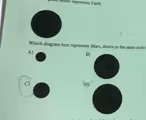
Now, let us evaluate the given options based on this information. The large circle at the top of the image represents Earth.
Option A shows a circle that is very small in comparison to the Earth circle, likely representing less than a quarter of its diameter. This depiction is too small for Mars.
Option B and Option D are incorrect as they show circles that are either close to Earth’s size or even larger. Mars is definitively smaller than Earth, so these options can be immediately dismissed.
Option C presents a circle whose diameter is approximately half that of the circle representing Earth. This visual representation aligns perfectly with the known scientific data that Mars’s diameter is about 53% of Earth’s. The size relationship is correctly illustrated.
In terms of volume, the difference is even more pronounced. Because volume is calculated based on the cube of the radius, Earth’s volume is more than six times greater than that of Mars. This substantial difference in size, mass, and volume is a fundamental characteristic of the two neighboring planets. Therefore, the diagram in option C is the most accurate scaled representation of Mars next to Earth.