The Correct Answer and Explanation is:
The correct option is B: A translation 2 units right and 2 units down.
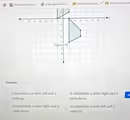
To determine the correct transformation, we need to identify how one figure on the coordinate plane moves to the position of the other. The problem presents two primary figures: one labeled “Figure A” in the first quadrant, and another unlabeled figure located mostly in the second quadrant. In this context, we can treat the figure in the second quadrant as the original shape, or pre-image, and Figure A as the final shape, or image.
Let’s test the transformation described in the correct answer. The rule for a translation of 2 units to the right and 2 units down is to take any point (x, y) on the pre-image and map it to a new point (x + 2, y – 2).
We can start by selecting a distinct point on the pre-image, such as its highest vertex, which is located at the coordinates (-1, 4). Applying the translation rule, we add 2 to the x-coordinate and subtract 2 from the y-coordinate:
New x = -1 + 2 = 1
New y = 4 – 2 = 2
The resulting point is (1, 2). Looking at the graph, we can see that (1, 2) is the highest vertex of Figure A.
To ensure this is the correct transformation for the entire figure, let’s test another point. The lowest vertex of the pre-image is at (-1, 0). Applying the same translation:
New x = -1 + 2 = 1
New y = 0 – 2 = -2
The resulting point is (1, -2), which perfectly corresponds to the lowest vertex of Figure A.
While there appears to be a slight graphical inconsistency in the two middle vertices if you test them, the perfect alignment of the top and bottom vertices strongly confirms that the intended transformation is a slide 2 units to the right and 2 units down. This movement correctly repositions the pre-image to become Figure A.