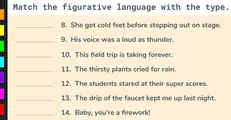
The Correct Answer and Explanation is:
Of course. Here are the correct matches for the figurative language types, followed by a detailed explanation.
Correct Answers
- Idiom: She got cold feet before stepping out on stage.
- Simile: His voice was as loud as thunder.
- Hyperbole: This field trip is taking forever.
- Personification: The thirsty plants cried for rain.
- Alliteration: The students stared at their super scores.
- Onomatopoeia: The drip of the faucet kept me up last night.
- Metaphor: Baby, you’re a firework!
Explanation
Figurative language uses words in a way that deviates from their literal meaning to create a more powerful, vivid, or imaginative effect. Each sentence in the list provides a clear example of a specific type.
An idiom, seen in sentence 8, is a common phrase whose meaning is not deducible from the literal definition of the words themselves. “To get cold feet” does not mean a person’s feet are physically cold; it is a widely understood expression for becoming nervous or scared enough to reconsider doing something.
A simile, used in sentence 9, is a comparison between two different things using the words “like” or “as.” The sentence “His voice was as loud as thunder” directly compares the volume of his voice to the sound of thunder using the word “as.”
Hyperbole is the use of extreme exaggeration for emphasis or effect, as shown in sentence 10. The field trip is not literally “taking forever,” but this overstatement effectively communicates the speaker’s feeling that it is lasting a very long time.
Personification gives human qualities or actions to inanimate objects or abstract ideas. In sentence 11, the “thirsty plants cried for rain.” Plants cannot literally cry, but attributing this human action to them vividly illustrates their desperate need for water.
Alliteration is the repetition of the same initial consonant sound in a series of words. Sentence 12, “The students stared at their super scores,” uses the repeating “s” sound at the beginning of four words to create a pleasing and noticeable phonetic rhythm.
Onomatopoeia is a word that phonetically imitates or suggests the sound that it describes. In sentence 13, the word “drip” is an example of onomatopoeia because the word itself sounds like the noise a faucet makes when it leaks.
Finally, a metaphor, seen in sentence 14, is a direct comparison that states one thing is another, without using “like” or “as.” By saying, “Baby, you’re a firework,” the speaker is directly comparing the person to a firework, suggesting they are dazzling, exciting, and full of life.