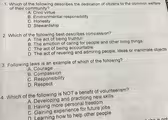
The Correct Answer and Explanation is:
Of course. Here are the correct answers and a detailed explanation for each question.
1. Correct Answer: A. Civic virtue
Civic virtue is the most accurate term to describe a citizen’s dedication to the common welfare of their community. This concept encompasses the personal qualities and habits necessary for a society to function successfully. It involves prioritizing the health, prosperity, and common good of the community over purely personal interests. While honesty and stewardship are components of civic virtue, and environmental responsibility is a specific type of it, “civic virtue” is the overarching term that best captures the commitment of a citizen to their society as a whole.
2. Correct Answer: B. The emotion of caring for people and other living things
Compassion is fundamentally an emotional response to the suffering of others that includes a desire to help. It is about empathy, caring, and a deep sense of connection to the well being of others. Option B perfectly encapsulates this definition. The other options describe different values. Option A, being truthful, defines honesty. Option C, being accountable, refers to responsibility. Option D, revering and admiring people or ideas, describes reverence or admiration, which is different from the sympathetic and caring nature of compassion.
3. Correct Answer: C. Responsibility
Following laws is a fundamental example of social and civic responsibility. As members of a structured society, citizens have a duty or obligation to adhere to the established rules and regulations that ensure order, safety, and fairness for everyone. This act is a core part of fulfilling one’s role within the community. While following a just law could be seen as showing respect for the system (D), the primary concept it demonstrates is the acceptance of one’s responsibility to uphold the social contract. It does not typically require courage (A) or compassion (B) in the act itself.
4. Correct Answer: B. Having more personal freedom

Volunteerism is the act of freely giving one’s time and effort to a cause. While it offers many benefits, it does not lead to more personal freedom. In fact, volunteering involves a commitment that reduces the amount of free time an individual has. It requires scheduling and dedicating hours that could have been used for personal leisure or other activities. Therefore, it is a purposeful restriction of one’s personal freedom for the benefit of others. The other options are all well known benefits of volunteering: it helps in developing new skills (A), provides valuable experience for future employment (C), and teaches individuals how to effectively help others (D).