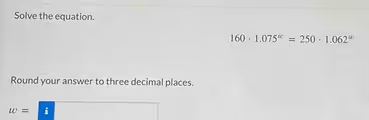
The Correct Answer and Explanation is:
w ≈ 36.680
To solve the equation 160 ⋅ 1.075^w = 250 ⋅ 1.062^w, we need to isolate the variable w, which is in the exponent. This requires using logarithms.
First, we rearrange the equation to group the terms with the variable w on one side and the constant terms on the other. We can do this by dividing both sides by 160 and also dividing both sides by 1.062^w.
Start with the original equation:
160 ⋅ 1.075^w = 250 ⋅ 1.062^w
Divide both sides by 1.062^w:
160 ⋅ (1.075^w / 1.062^w) = 250
Divide both sides by 160:
(1.075^w / 1.062^w) = 250 / 160
Next, we simplify both sides. On the left, we use the exponent property (a^x / b^x) = (a/b)^x. On the right, we simplify the fraction.
(1.075 / 1.062)^w = 1.5625
To solve for the exponent w, we take the natural logarithm (ln) of both sides of the equation.
ln[(1.075 / 1.062)^w] = ln(1.5625)
Using the power rule of logarithms, which is ln(a^b) = b ⋅ ln(a), we can move the exponent w to the front as a coefficient:
w ⋅ ln(1.075 / 1.062) = ln(1.5625)
Finally, to isolate w, we divide both sides by ln(1.075 / 1.062):
w = ln(1.5625) / ln(1.075 / 1.062)
Now, we use a calculator to find the numerical value:
w ≈ 0.4462871 / 0.0121668
w ≈ 36.68007…
The problem requires the answer to be rounded to three decimal places. The fourth decimal place is 0, so we round down.
Therefore, w ≈ 36.680.