The Correct Answer and Explanation is:
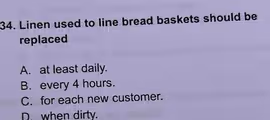
The correct answer is C. for each new customer.
This is the correct choice because it is the most effective practice for ensuring food safety and hygiene in a dining environment. The primary concern with items like bread basket liners is the prevention of cross contamination between different groups of diners. When customers take bread from a basket, they often touch the linen liner, potentially transferring germs and bacteria from their hands onto the fabric. If that same liner is then given to a new table of customers, those microorganisms can be passed along, creating a risk for the spread of illness.
Replacing the linen for each new customer is the only way to guarantee that every party receives a clean, sanitary basket. This practice aligns with the fundamental principles of food service sanitation, which dictate that items that come into contact with a customer must be cleaned and sanitized before being used by another. This includes tableware, glasses, and cutlery, and the same standard should apply to the linen in a bread basket.
The other options are inadequate from a food safety perspective. Changing the linen only “when dirty” is unreliable, as harmful pathogens are microscopic and not visible. A liner could look clean but be contaminated. Likewise, replacing it on a time based schedule, such as “at least daily” or “every 4 hours,” fails to address the core issue. A basket could be used by several different tables within a four hour or even one hour window, allowing germs to spread from one group to the next. Therefore, the only practice that effectively eliminates this risk is to provide a fresh, clean linen for every new customer.