The Correct Answer and Explanation is:
The correct answer is 12.
There are 12 possible outcomes for a lunch combination and a piece of fruit. This problem can be solved by analyzing the provided tree diagram or by using a mathematical concept known as the Fundamental Counting Principle.
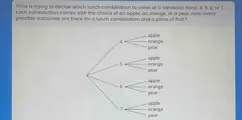
The problem states that Timo must make two separate choices to create his lunch. The first choice is the main lunch combination, and there are four options available: 4, 5, 6, or 7. The second choice is the side of fruit, and for each lunch combination, there are three fruit options: an apple, an orange, or a pear.
The tree diagram visually represents all the possible pairings. The starting point on the left branches out into four main limbs, one for each lunch combination (4, 5, 6, and 7). Then, each of these four limbs further splits into three smaller branches, representing the three fruit choices. To find the total number of unique outcomes, you can count the final endpoints at the far right of the diagram. There are four groups of three, so you can calculate the total by adding them together: 3 + 3 + 3 + 3 = 12.
Alternatively, the Fundamental Counting Principle provides a direct way to calculate the total number of outcomes. This principle states that if you have multiple independent events, you can find the total number of possible outcomes by multiplying the number of options for each event. In this case, there are 4 options for the first event (choosing the lunch combination) and 3 options for the second event (choosing the fruit). By multiplying these numbers, you get 4 × 3 = 12. Both methods confirm that there are 12 different possible lunch outcomes for Timo to choose from.