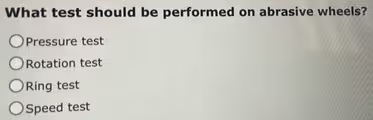
The Correct Answer and Explanation is:
The correct answer is Ring test.
A ring test is a critical and straightforward safety inspection that must be performed on vitrified abrasive wheels before they are mounted on a grinder. Its purpose is to detect hidden cracks or internal damage that may not be visible on the surface. Such damage could cause the wheel to shatter violently when it reaches operating speed, posing a severe risk of injury to the operator and anyone nearby.
The procedure for a ring test is simple. The wheel should be dry, clean, and suspended freely. This can be done by placing a finger through the arbor hole or by resting it on a pin or peg. Then, the wheel is gently tapped with a light, non-metallic object, such as the handle of a screwdriver or a wooden mallet. The tap should be applied about 45 degrees on each side of the vertical centerline and approximately one to two inches from the wheel’s edge.
If the wheel is in good condition, it will emit a clear, metallic ringing sound, much like a bell. This clear tone indicates that the wheel is structurally sound. Conversely, if the wheel is cracked or damaged, it will produce a dull thud or a dead sound. A wheel that produces this dull sound must be immediately taken out of service and destroyed to prevent accidental use.
While a “speed test” (or spin test) is also a vital safety step, where a newly mounted wheel is run at operating speed for at least a minute before use, the ring test is the specific pre-mounting inspection to check the wheel’s structural integrity. A “pressure test” is irrelevant for solid wheels, and “rotation test” is too general. The ring test is a named, universally recognized, and often legally mandated procedure for ensuring abrasive wheel safety.